Within 12 hours of a cease-fire signed with Gaza, ending 50 days of drawn-out war, Israel awoke last week to another immediate reality on its northern border: Mortar shells errantly lobbed by rebel forces clashing with President Bashar Assad's army, landed inside Israel's Golan Heights multiple times as rebels and Syrian forces enclosed their battles near the Quneitra crossing. Five days on, the Gaza war has been forgotten and Israeli interest has turned northward.
Israel's defense establishment is concerned by the heated battles along the Syrian border, but it is unlikely that the spillover from the north will result in any sort of persistent attacks or war. The battles along the Golan border are of yet contained and focused on Syrian territory, with no intelligence pointing at intentional crossover into Israel. Nevertheless, especially as United Nations forces controlling the border fall directly into the field of fighting, Israel is on alert and receptive.
The Quneitra border crossing, the only gate between Syria and Israel, was overtaken late last week by rebel forces comprising both the composite militias of secular fighters under the title of the former Free Syrian Army and jihadists aligned to the Al-Qaida linked Nusra Front. Quneitra is the sole crossing between Syria and Israel, and the territory near the border has been largely controlled over the last few months by Nusra rebels, who have an unconfirmed and silent gentleman's agreement with Israel to abstain from any infiltrations into its territory. The Syrian army has been fighting to retake the border, but the rebel forces are still in control.
Reports over the last months indicate that Nusra fighters were among the Syrian casualties treated by Israel both at its field hospital on the border and inside the territory over the last year, an indication of this silent security pact. Regardless of official confirmation of such a volatile agreement, the Israeli Golan remains safe from intentional attacks as the Syrian civil war, now shadowed by the presence of the Islamic State in Iraq and Syria, remains on the other side of the border.
Nusra is no friend of Israel – it is an Al-Qaida entity, with Jihadist intentions, a brutal army with relentless means of war. But it is also not ISIS (the Islamic State), from which it declared distance earlier this year. ISIS envisions global jihad, having already secured large territories in Syria and Iraq, toward both the Jordanian and Turkish borders. Its forces near the Golan border are small, located in nearby villages but not upon Israeli territory. Nusra comprises mainly fighters from Syria, jihadis and anti-Israel, not bent on entering or conquering the territory south of the border, but rather on fighting Assad forces and ensuring their control within Syria and its borders.
Since the end of the Yom Kippur War in 1973, the Quneitra crossing has been manned by the United Nations Disengagement Observatory Force (UNDOF). Late last week, following seizure of the crossing, the Nusra Front challenged UNDOF forces and demanded a handover of weapons. Forty-three UN soldiers, mainly from Fiji, adhered and were taken hostage. Another 81 UN soldiers, from the Philippines, refused surrender and barricaded themselves inside their position. On Saturday, Syrian reports emerged that dozens of the UN hostages were secured release by European forces (Irish) and made entry into Israel. Dozens still remain.
Israel is an integral component in deals pertaining to international elements harmed or abducted in Syria: Aside from the aforementioned treatment of wounded fighters and confirmed civilians from Syria, and the opening of its borders to freed UN and international elements, it also last week served as the crossing point for American journalist Pete Theo Curtis, who was freed via Qatar intervention after nearly two years in ISIS captivity. Israel's border with Syria is closed, opened in the last 30 years only to Druze citizens studying in Damascus or crossing over to marry in the northern country, and to the export of apples grown in the Golan. Israel wants this border to remain closed, for obvious security reasons, but is willing to engage itself in efforts for the safety of international forces and foreign journalists.
Israel's northern border is relatively safe of now, but the events on the Syrian side cannot be extracted from the developments both militarily and financially in the region, proving a change to the balance of power in the Middle East. Israel is fresh out of war, the Gaza Strip has yet to be rehabilitated or relieved of its years-long siege on air, sea and land ports. Southern communities along the Gaza border are at ill-ease, war-torn, and uncertain of their future security. Along with these considerations, Israel must now focus on its northern border, the strength of the rebel forces on the other side and the well-enforced entities guiding them financially.
Qatar, a small country with global financial and mediatory aspirations, is fighting to become a regional power. Along with Saudi Arabia, it is a crucial force in the containment and funding of Islamist entities in the Middle East. It attempted to mediate the truce between Israel and Gaza, but was overshadowed by Egypt. Its vociferous intentions to enter the role of major regional player should not be ignored however, despite its funding of Hamas and reported support of the Qaida-backed Nusra.
Israel would do well to take advantage of opportunity with Qatar, to secure both financial and security stability. There is no chance of diplomatic relations between the two countries: the gulf state is Islamic and funds anti-Israel elements. Nonetheless, Qatar wants to replace Saudi Arabia as the central force in the region. It is small, but determined. Israel should seize its chance with Qatar's aspirations to ensure not only security with Gaza, but the northern border as well.
World attention is now on ISIS and its brutalities, but a significant battle is being fought on Syria's border with Israel, and the rebel forces in control there. This is not global jihad, but a battle for Syria, a civil war that has already resulted in hundreds of thousands dead and 3 million refugees. Israel has involved itself in extracting hostages and wounded through its borders, safely distancing itself from military battle with forces on the other side. With a new Middle East order upon us, the question now is where and how Israel will react and with whom it will ally. The main concern for Israel must be safety along all borders, by whatever means necessary.
Showing posts with label Israel. Show all posts
Showing posts with label Israel. Show all posts
Saturday, August 30, 2014

Friday, August 22, 2014
Dead or alive, Deif assassination attempt was a victory for Israel
The question of whether Hamas' military commander Mohammed Deif was indeed assassinated in the attack on his ostensible hideout in Gaza City Tuesday night has still not been answered, but the attempt itself scored Israel two major points: It proved the drastic improvement of Israel's intelligence capabilities in the Gaza Strip, narrowing down the location of top players in the military wing, and served as a major public relations victory in showing that Israel's main targets are the senior commanders overseeing Hamas' battles and rocket operation, rather than indiscriminate civilians.
The focus of Israel's operation in Gaza has moved beyond the mostly destroyed tunnels and waning rocket caches that the 45-day war has centered on so far: it is now the military commanders in charge of Hamas' activities that have returned to the lens of the Israeli defense establishment's periscope. Targeted assassinations have long been a part of Israel's modus operendi against terrorist entities, from Hamas to Hezbollah, and have resumed in full force following the collapse of the cease-fire talks in Cairo.
Deif's wife, infant son and teenaged daughter were killed in the attack on the home of Mohammed Yassin Dalou, the chief rocket commander in Gaza and member of an integral family of Hamas activists. The successful or failed attempt on Deif's own life, yet to be verified, was followed by two more thorough and proven assassinations the next night: the senior commander of the southern Gaza brigades, Mohammed Abu Shamaleh, and his Rafah brigadier, Raed al-Attar, integral elements in that region of the Strip, both heavily involved in the captures of Corp. Gilad Shalit in 2006 and of Liet. Hadar Goldin last month. These assassinations have severely weakened Gaza's southern command; though Hamas' military leaders are largely interchangeable, these were rocket and battle experts with lengthy experience and heavy authority over Rafah and the surrounding area. For the near future at least, Rafah under Hamas is unguided, and under uncertain command.
Israel was able to pinpoint both the location of the Deif family and that of the two southern brigadiers through huminet intelligence, its strongest yet in a war of limited Shin Bet sources, following three failed cease-fires and dead-end negotiations. Twenty-one collaborators are said to have been executed by Hamas following the assassinations, indications of the veracity of this cooperation and of others yet to emerge.
Hamas insists that Deif was unharmed in the attack on the Dalou home, declaring the day after his alleged assassination that he was alive and well and remained the commander who would lead the units to conquest of the Al-Aqsa Mosque in Jerusalem. Yet most analysts, and basic intelligence, estimate that Deif was killed in the attempt. Deif was already severely disabled by four prior attempts by Israel on his life, and served in the last few years as a figurehead alone, while the actual operations were overseen by acting chief Marwan Issa. Without video proof or at least an audio message from Deif, there can be no clear verification of his survival or demise.
Palestinian news agencies released a certificate of death containing two names immediately following the fatal attack on the Al-Sultan neighborhood in Gaza, where the Dalou family lives and the Deifs were staying: those of Deif's wife Widad, and their 7-month-old son Ali. A second certificate circulated by the Gazan agency Saham News hours later showed a near identical document, with another line inserted above, naming Mohammed Deif, born in 1965, as a third fatality in the attack. Both documents are suspect to forgery; no clear answer has yet emerged which was indeed doctored, or by whom.
Palestinian Authority President Mahmoud Abbas held a little-publicized, but very important meeting with Hamas' political chief Khaled Meshal on Thursday in Doha, alongside the chief Palestinian negotiator to the Cairo talks, Ahmed al Azzam, and the Qatari ruler Sheikh Tamim bin Hamad Al Thani.
At the end of these talks, Meshal plans to travel to Cairo with Abbas, for the first time since his visit to Gaza two years ago, as a persona very non grata in Egypt. The decision whether Egypt will allow his entry depends on the outcome of Thursday night's discussions: he will likely only be invited into Cairo if the talks with the Palestinian Authority delegation yields results for a future arrangement and if his purpose in Cairo is to close such a deal.
Deif, by most intelligence and basic scenarios, did not manage to reach his ninth cat life, nor even a fifth miraculous survival of Israeli assassination attempts. He has already achieved godlike status in Gaza, despite holding only a nominal commander status since his last devastating injury by Israel in 2006.
Israel's assassination policies, harsh and lethal and of inevitable costs, have been questioned numerous times as to whether they are effective or a waste of energy and life. With Meshal now begging to return to Cairo, no sign of truce ahead and a severe Israeli intelligence dart on the heads of Gaza's military commanders, this policy seems ever more effective – not marked just by those who are killed, but by who is targeted and at what proximity.
Mohammed Deif, a skeleton of a human from four assassination attempts, is not only a figurehead commander to Hamas: he is a figurehead in Israel's targeted attempts as well. He has died four times before, one more, even final, will hardly make a difference. The tie has been broken by proof of Israel's intelligence in Gaza as the war enters its 46th day without sign of relent. Hamas has just a few thousand rockets remaining, but wants a war of attrition, willing to fight to the last explosive. Israel can now accede, knowing the attrition is on its side. Its army is strong and its intelligence in a formerly off-limits territory is tight, capable of weakening Hamas. The arm wrestle is on. One side must give. Hamas, always first to throw the shots, is already buckling. The only victory now will be back on the diplomatic battlefields of Cairo.
The focus of Israel's operation in Gaza has moved beyond the mostly destroyed tunnels and waning rocket caches that the 45-day war has centered on so far: it is now the military commanders in charge of Hamas' activities that have returned to the lens of the Israeli defense establishment's periscope. Targeted assassinations have long been a part of Israel's modus operendi against terrorist entities, from Hamas to Hezbollah, and have resumed in full force following the collapse of the cease-fire talks in Cairo.
Deif's wife, infant son and teenaged daughter were killed in the attack on the home of Mohammed Yassin Dalou, the chief rocket commander in Gaza and member of an integral family of Hamas activists. The successful or failed attempt on Deif's own life, yet to be verified, was followed by two more thorough and proven assassinations the next night: the senior commander of the southern Gaza brigades, Mohammed Abu Shamaleh, and his Rafah brigadier, Raed al-Attar, integral elements in that region of the Strip, both heavily involved in the captures of Corp. Gilad Shalit in 2006 and of Liet. Hadar Goldin last month. These assassinations have severely weakened Gaza's southern command; though Hamas' military leaders are largely interchangeable, these were rocket and battle experts with lengthy experience and heavy authority over Rafah and the surrounding area. For the near future at least, Rafah under Hamas is unguided, and under uncertain command.
Israel was able to pinpoint both the location of the Deif family and that of the two southern brigadiers through huminet intelligence, its strongest yet in a war of limited Shin Bet sources, following three failed cease-fires and dead-end negotiations. Twenty-one collaborators are said to have been executed by Hamas following the assassinations, indications of the veracity of this cooperation and of others yet to emerge.
Hamas insists that Deif was unharmed in the attack on the Dalou home, declaring the day after his alleged assassination that he was alive and well and remained the commander who would lead the units to conquest of the Al-Aqsa Mosque in Jerusalem. Yet most analysts, and basic intelligence, estimate that Deif was killed in the attempt. Deif was already severely disabled by four prior attempts by Israel on his life, and served in the last few years as a figurehead alone, while the actual operations were overseen by acting chief Marwan Issa. Without video proof or at least an audio message from Deif, there can be no clear verification of his survival or demise.
Palestinian news agencies released a certificate of death containing two names immediately following the fatal attack on the Al-Sultan neighborhood in Gaza, where the Dalou family lives and the Deifs were staying: those of Deif's wife Widad, and their 7-month-old son Ali. A second certificate circulated by the Gazan agency Saham News hours later showed a near identical document, with another line inserted above, naming Mohammed Deif, born in 1965, as a third fatality in the attack. Both documents are suspect to forgery; no clear answer has yet emerged which was indeed doctored, or by whom.
Palestinian Authority President Mahmoud Abbas held a little-publicized, but very important meeting with Hamas' political chief Khaled Meshal on Thursday in Doha, alongside the chief Palestinian negotiator to the Cairo talks, Ahmed al Azzam, and the Qatari ruler Sheikh Tamim bin Hamad Al Thani.
At the end of these talks, Meshal plans to travel to Cairo with Abbas, for the first time since his visit to Gaza two years ago, as a persona very non grata in Egypt. The decision whether Egypt will allow his entry depends on the outcome of Thursday night's discussions: he will likely only be invited into Cairo if the talks with the Palestinian Authority delegation yields results for a future arrangement and if his purpose in Cairo is to close such a deal.
Deif, by most intelligence and basic scenarios, did not manage to reach his ninth cat life, nor even a fifth miraculous survival of Israeli assassination attempts. He has already achieved godlike status in Gaza, despite holding only a nominal commander status since his last devastating injury by Israel in 2006.
Israel's assassination policies, harsh and lethal and of inevitable costs, have been questioned numerous times as to whether they are effective or a waste of energy and life. With Meshal now begging to return to Cairo, no sign of truce ahead and a severe Israeli intelligence dart on the heads of Gaza's military commanders, this policy seems ever more effective – not marked just by those who are killed, but by who is targeted and at what proximity.
Mohammed Deif, a skeleton of a human from four assassination attempts, is not only a figurehead commander to Hamas: he is a figurehead in Israel's targeted attempts as well. He has died four times before, one more, even final, will hardly make a difference. The tie has been broken by proof of Israel's intelligence in Gaza as the war enters its 46th day without sign of relent. Hamas has just a few thousand rockets remaining, but wants a war of attrition, willing to fight to the last explosive. Israel can now accede, knowing the attrition is on its side. Its army is strong and its intelligence in a formerly off-limits territory is tight, capable of weakening Hamas. The arm wrestle is on. One side must give. Hamas, always first to throw the shots, is already buckling. The only victory now will be back on the diplomatic battlefields of Cairo.
Thursday, August 7, 2014
The Gaza-Israel war isn't over yet
Israel withdrew all of its forces from the Gaza Strip on Tuesday morning, at the exact moment that the 72-hour Egyptian-brokered truce was scheduled to begin and just as Hamas finished firing its last punctuating barrage of rockets, at the second the clock ticked 8 A.M. The cease-fire has held for nearly 48 hours now, but the war is not quite over, and this never-ending conflict between neighbors in such close quarters is even further from being resolved.
Both Hamas and Israel want this fragile truce, hinging on the current talks in Cairo, to extend beyond the Friday morning deadline – neither is prepared to return to war at this moment, but rifts are clear in the negotiations. Aside from the demands posed by Hamas, toward which both Israel and the external mediators are willing to show flexibility, there is one post-truce outcome that Israel is not prepared to abandon and that Hamas refuses to accept: demilitarization.
Hamas and the Palestinian factions of Gaza knelt this week in unconditional surrender to the Egyptian cease-fire draft, stipulating a 3-day lull in fighting before resumption of negotiations on any future agreements. It was the same exact same offer they rejected three weeks ago, before Israel embarked on its ground operation, and that they nixed once again last Friday after accepting and then rescinding with attacks on Israeli forces 90 minutes into that truce. They finally realized that there is no alternative to this offer they could not refuse and had refused twice already. Israel, which declared unilateral withdrawal and boycotted the Cairo truce talks earlier this week, emerged the strategic victor: the outline it drafted with Egypt at the beginning of the war is nearly one in the same as that which Hamas agreed to, the failed interventions of Qatar, Turkey and the U.S. in the last weeks filed and forgotten.
Hamas presented a 10-point list of demands in Qatar last month, as that aspiring political power attempted to mediate, including inter alia a withdrawal of Israeli forces, a cessation of operation on the tunnels, the opening of border crossings, the establishment of sea and air ports, a 6-12 nautical mile fishing zone, a lifting of the blockade, and the release of prisoners. Save the first two demands – which Israel carried out unilaterally – the subsequent clauses were omitted from the Egyptian outline, which in its presentation to Hamas is nearly identical to its initial form. Each of the following demands is still up for negotiation, and proposals on how to meet them in a way amenable to Israel and the international community are under discussion.
Israel has already begun to repair the border fence with Gaza and has lifted both the roadblocks in southern communities and the Home Front guidelines on safety during wartime, calling on citizens to resume routine; residents are free to return home, though most are reticent, filled still with the fear of a monster emerging from a tunnel under their children's beds, a real and concrete threat while the tunnels remained unmonitored.
In Gaza, the devastation is extreme. Nearly 1880 people have been killed, almost 10,000 wounded, and a quarter of the population has been displaced. The damage is estimated at some $5 billion. Aid has already begun flowing in: international entities from the UN to member countries, including Italy, U.S., Turkey, and the International Red Cross have sent tons of assistance; Israeli electric teams are working to repair the destroyed power lines and hundreds of truckloads of aid have passed through the Israeli border to Gaza. This rehabilitation will take years to conclude.
A generation of Palestinians in Gaza will not forget this war. Like their neighbors on the Israeli side, there is no guarantee that a monster will not attack in the middle of the night. Their parents have been killed, they have been dismembered, and their homes have been destroyed. A generation of Israelis is filled with the same hatred, not just toward Gazans, but toward all Arabs and Palestinians: these are their monsters, not innocent children, nor women, nor civilians; monsters that must be destroyed. The hatred the world hoped had been eradicated in the 10 years since the second intifada is stronger than ever.
Israel's hidden agenda, unsaid amid the very real rhetoric of destroying tunnels and halting rocket attacks, was to imbue in Gazans the realization that Hamas was a political force capable only of devastation and self-destruction, and thus lead to a democratic choice to let the Palestinian Authority resume control of the territory.
"Israel is hoping that external pressure from the outside might be combined with the internal pressure of people from Gaza when they realize the devastation [the Hamas leadership causes]," a former Israeli security official told me. "They might resist or at least complain, and these two pressures might bring a regime change, political change that might guarantee no more attacks [against Israel]."
This hope is optimistic at best and catastrophically self-defeating at worse. Hamas' popularity, as a resistance army capable of standing its own against one of the great militaries in the world for nearly a month, is higher than it was before the war. Even if the PA assumes control of the border crossings, and even if the unity agreement is reworded with Hamas to enable a democratic realization of this security situation, most Gazans do not see Hamas as the enemy Israel had hoped they would – they are disillusioned by war, and eager to live in peace and quiet, but they do not embrace Israel's rhetoric of Hamas as their primary monster.
If this cease-fire indeed manages to hold for the three days stipulated and beyond, it will be very difficult for Hamas to return to war. Israel has publicly disengaged, on alert in the area, but not in war mode. Hamas has lost nearly 2/3 of its arsenal and its tunnel operations are under tight Israeli surveillance.
The first two days of cease-fire have left Israelis and Gazans alike unsettled: there is no guarantee that the other side won't attack or that this respite is anything more than just biding time until the next war. For many Israelis, the disappointment stems from a sentiment that the goal of wiping out Hamas' capabilities has not been achieved. Infiltrations and rocket attacks are still possible: Gaza militants have 3,000 rockets and 10,000 mortar shells and Israeli intelligence on the tunnels is better than ever, but still limited. The army announced that its operation on the tunnels had ended after 32 were located and destroyed – but it is well aware that more exist beyond their intelligence.
For both Israelis in the south and Gazans, the basic activities of sleep, shopping, and going about daily life still just a cautious dream; for Gazans, the world as they knew it is devastated beyond belief.
A third intifada will emerge quicker than its predecessors unless the negotiations in Egypt following this quick truce stamp it down. Gazans, mainstream Israelis, and West Bank Palestinians are war-worn and hateful of their enemies. Prime Minister Benjamin Netanyahu, whose calculated decisions over the last month have won him enormous ratings in Israel, must take this final and waning opportunity to negotiate a settlement with Palestinian President Mahmoud Abbas, the caretaker of not only the West Bank and East Jerusalem, but now also the Gaza Strip, as its unity agreement with Hamas unfolds in the most concrete terms amid the Islamist leadership's loss of functional control over its territory.
The stakes are higher than ever. The future of both Palestinian and Israeli security now rest in the hands of Egypt, which has sidestepped the U.S. as the strongest mediatory force in the region; months of negotiations, rehabilitation, and security arrangements are still ahead. Anyone quick enough to say this war is over will find themselves just as quickly back in battlefield again.
Both Hamas and Israel want this fragile truce, hinging on the current talks in Cairo, to extend beyond the Friday morning deadline – neither is prepared to return to war at this moment, but rifts are clear in the negotiations. Aside from the demands posed by Hamas, toward which both Israel and the external mediators are willing to show flexibility, there is one post-truce outcome that Israel is not prepared to abandon and that Hamas refuses to accept: demilitarization.
Hamas and the Palestinian factions of Gaza knelt this week in unconditional surrender to the Egyptian cease-fire draft, stipulating a 3-day lull in fighting before resumption of negotiations on any future agreements. It was the same exact same offer they rejected three weeks ago, before Israel embarked on its ground operation, and that they nixed once again last Friday after accepting and then rescinding with attacks on Israeli forces 90 minutes into that truce. They finally realized that there is no alternative to this offer they could not refuse and had refused twice already. Israel, which declared unilateral withdrawal and boycotted the Cairo truce talks earlier this week, emerged the strategic victor: the outline it drafted with Egypt at the beginning of the war is nearly one in the same as that which Hamas agreed to, the failed interventions of Qatar, Turkey and the U.S. in the last weeks filed and forgotten.
Hamas presented a 10-point list of demands in Qatar last month, as that aspiring political power attempted to mediate, including inter alia a withdrawal of Israeli forces, a cessation of operation on the tunnels, the opening of border crossings, the establishment of sea and air ports, a 6-12 nautical mile fishing zone, a lifting of the blockade, and the release of prisoners. Save the first two demands – which Israel carried out unilaterally – the subsequent clauses were omitted from the Egyptian outline, which in its presentation to Hamas is nearly identical to its initial form. Each of the following demands is still up for negotiation, and proposals on how to meet them in a way amenable to Israel and the international community are under discussion.
Israel has already begun to repair the border fence with Gaza and has lifted both the roadblocks in southern communities and the Home Front guidelines on safety during wartime, calling on citizens to resume routine; residents are free to return home, though most are reticent, filled still with the fear of a monster emerging from a tunnel under their children's beds, a real and concrete threat while the tunnels remained unmonitored.
In Gaza, the devastation is extreme. Nearly 1880 people have been killed, almost 10,000 wounded, and a quarter of the population has been displaced. The damage is estimated at some $5 billion. Aid has already begun flowing in: international entities from the UN to member countries, including Italy, U.S., Turkey, and the International Red Cross have sent tons of assistance; Israeli electric teams are working to repair the destroyed power lines and hundreds of truckloads of aid have passed through the Israeli border to Gaza. This rehabilitation will take years to conclude.
A generation of Palestinians in Gaza will not forget this war. Like their neighbors on the Israeli side, there is no guarantee that a monster will not attack in the middle of the night. Their parents have been killed, they have been dismembered, and their homes have been destroyed. A generation of Israelis is filled with the same hatred, not just toward Gazans, but toward all Arabs and Palestinians: these are their monsters, not innocent children, nor women, nor civilians; monsters that must be destroyed. The hatred the world hoped had been eradicated in the 10 years since the second intifada is stronger than ever.
Israel's hidden agenda, unsaid amid the very real rhetoric of destroying tunnels and halting rocket attacks, was to imbue in Gazans the realization that Hamas was a political force capable only of devastation and self-destruction, and thus lead to a democratic choice to let the Palestinian Authority resume control of the territory.
"Israel is hoping that external pressure from the outside might be combined with the internal pressure of people from Gaza when they realize the devastation [the Hamas leadership causes]," a former Israeli security official told me. "They might resist or at least complain, and these two pressures might bring a regime change, political change that might guarantee no more attacks [against Israel]."
This hope is optimistic at best and catastrophically self-defeating at worse. Hamas' popularity, as a resistance army capable of standing its own against one of the great militaries in the world for nearly a month, is higher than it was before the war. Even if the PA assumes control of the border crossings, and even if the unity agreement is reworded with Hamas to enable a democratic realization of this security situation, most Gazans do not see Hamas as the enemy Israel had hoped they would – they are disillusioned by war, and eager to live in peace and quiet, but they do not embrace Israel's rhetoric of Hamas as their primary monster.
If this cease-fire indeed manages to hold for the three days stipulated and beyond, it will be very difficult for Hamas to return to war. Israel has publicly disengaged, on alert in the area, but not in war mode. Hamas has lost nearly 2/3 of its arsenal and its tunnel operations are under tight Israeli surveillance.
The first two days of cease-fire have left Israelis and Gazans alike unsettled: there is no guarantee that the other side won't attack or that this respite is anything more than just biding time until the next war. For many Israelis, the disappointment stems from a sentiment that the goal of wiping out Hamas' capabilities has not been achieved. Infiltrations and rocket attacks are still possible: Gaza militants have 3,000 rockets and 10,000 mortar shells and Israeli intelligence on the tunnels is better than ever, but still limited. The army announced that its operation on the tunnels had ended after 32 were located and destroyed – but it is well aware that more exist beyond their intelligence.
For both Israelis in the south and Gazans, the basic activities of sleep, shopping, and going about daily life still just a cautious dream; for Gazans, the world as they knew it is devastated beyond belief.
A third intifada will emerge quicker than its predecessors unless the negotiations in Egypt following this quick truce stamp it down. Gazans, mainstream Israelis, and West Bank Palestinians are war-worn and hateful of their enemies. Prime Minister Benjamin Netanyahu, whose calculated decisions over the last month have won him enormous ratings in Israel, must take this final and waning opportunity to negotiate a settlement with Palestinian President Mahmoud Abbas, the caretaker of not only the West Bank and East Jerusalem, but now also the Gaza Strip, as its unity agreement with Hamas unfolds in the most concrete terms amid the Islamist leadership's loss of functional control over its territory.
The stakes are higher than ever. The future of both Palestinian and Israeli security now rest in the hands of Egypt, which has sidestepped the U.S. as the strongest mediatory force in the region; months of negotiations, rehabilitation, and security arrangements are still ahead. Anyone quick enough to say this war is over will find themselves just as quickly back in battlefield again.
Friday, August 1, 2014
Hamas can't lose this war, because it has nothing to lose
Ninety minutes into a 72-hour humanitarian truce facilitated by Egypt and reluctantly agreed to by Hamas, the calm was shattered and the fighting resumed. Palestinian militants opened fire on Israeli forces in south Gaza, prompting an artillery response from the Israel Defense Forces; rockets were fired at southern Israel and fierce battles ensued in the Strip. The fighting continued to escalate over the course of the morning and afternoon, with at least 90 Palestinians and two Israeli soldiers killed, a third said kidnapped by Hamas; the temporary truce, the longest scheduled lull to date in this operation, was halted in its infancy and forgotten - back to the battlefield and back to the drawing board.
By agreeing to the lengthy truce, Hamas in effect surrendered – to Israel's military pressure, to the superiority of the Palestinian Authority pushing it into negotiations, and to the Egyptian mediators drafting the terms of the proposal. It is not known whether the breach of truce on Friday morning was carried out by Hamas local militants at their own discretion or upon orders of the top echelon. The latter is unlikely, but regardless of which militants attacked and on what level, it is Hamas' political leadership that ultimately answers to and accepts responsibility for every military action, as the rulers of the Gaza Strip.
Egypt told the Palestinians this week, following the snub of its exclusion from U.S. Secretary of State John Kerry's intervention, that they would not be invited back to Cairo for further negotiations until a temporary cease-fire had been set in place. Palestinian President Mahmoud Abbas met with Hamas political leader Khaled Meshal on Thursday in a furious bid to convince him to agree to Egypt's terms and to a temporary lull, as the only way to set into motion negotiations for an actual end to the war. Hamas is a serious organization with a calculated political echelon. Meshal's word to abide by the truce was solid, indicating the Hamas political echelon's readiness to take the next step and move toward a permanent agreement.
The 72-hour truce was intended to give the sides the necessary time to hash out the details of Egypt's revised draft – one that included numerous changes acquiescing to Hamas' demands, particularly freedom of movement through Gaza's southern border crossing. With calm on the battle front, an amenable agreement could be determined and the real negotiations – on the future security arrangements in Gaza and on its borders – could begin. Following the breach of truce, Egypt informed Israel and the Palestinians that its delegations were no longer expected in Cairo on Friday, its conditions firm and unchanged: No negotiations until a temporary cease-fire is in place.
The Hamas leadership is divided into three hierarchical but highly coordinated governing bodies: the Majlis al-Shura, a religious council nominally in charge of the movement's strategic decisions and supervision of its activities; followed by the political bureau, run by Khaled Meshal from Qatar and Ismail Haniyeh, his chief deputy in Gaza; and the subordinate Iz A-din Qassam Brigades, the movement's military wing.
Hierarchy aside, the three bodies' decisions are made in tandem with one another. The military wing is not a renegade branch free to act of its accord. Every decision on the military front must be made with the knowledge and blessing of the political wing and the ruling council. There are cracks in communication, however, and not all orders are carried out; a likely explanation of the initial breach of truce on Friday morning: This is particularly true among the rank-and-file of Hamas' military command, where there is a growing sense of distance and abandonment from the political leadership. If it was Hamas that breached the truce on Friday – and not members of a separate Palestinian faction – it was a decision made within the mid-level military command, either by militants in the trenches unaware that a cease-fire had been declared or by those acting in defiance of political order. Regardless of why and how the breach of truce emerged, however, Hamas has in its wake withdrawn from its agreement and returned to battle mode.
Hamas opened this war three weeks ago because it had nothing to lose: it knew that firing rockets on Israel would draw fierce aerial attacks and likely lead to a ground invasion, along with a serious death toll among its civilian population; it knew that its long-range rocket supply would be wiped out by rapid fire and Israeli strikes, and it knew that even if it won back its former allies Hezbollah and Iran, there was no way they could help replenish its arsenal or that arms would flow again into its tightly secured borders.
Hamas also knew that it had surprise weaponry and strategies capable of inflicting more harm than either Israel or the world could have anticipated. Through its labyrinth of tunnels it managed to store hundreds of mid-range and dozens of long-range rockets (far beyond Israeli intelligence estimates), and beyond that, its greatest weapon of all: the ability to infiltrate Israel and launch its own ground incursion on enemy territory.
Hamas militants have managed to enter Israel through these tunnels at least five times in three weeks, a number of ambushes into Israeli territory unseen since the war in 1948. A 3 km security zone has been demarcated along the border inside Gaza, but no such buffer is in place inside Israel – civilians and soldiers sit meters from the border, on top of the tunnel openings. Israeli forces have located and destroyed dozens of the tunnels inside Gaza, but many remain hidden, including the openings into Israeli territory. The infiltrations can and will continue until either a cease-fire is secured or Israel is forced to evacuate its border towns and create a security strip of significant radius – a complicated and strategically difficult endeavor.
In battle terms, Israel has already won this war: 63 soldiers killed and three civilians, compared to more than 1,450 Palestinian fatalities, among them 400-500 combatant according to IDF estimates, and unimaginable destruction of Gaza's cities and villages. Hamas' leaders have already bent to political pressure, prepared to negotiate, but are of the same mind as their militants and those of the other Palestinian factions – no surrender and no end except on their own terms. Hamas can't lose this war, because they have nothing to lose. Its militants are prepared to fight until Israel, military power or not, cries uncle – or until the powers negotiating a permanent agreement relent, and include its terms in their entirety, an unlikely scenario at this point. Gaza may be demilitarized in the end, as Israel and Egypt hope, but it may well be through Hamas' own self-destruction, in months and countless deaths ahead. Without a quick and immediate cease-fire, this war will continue indefinitely.
By agreeing to the lengthy truce, Hamas in effect surrendered – to Israel's military pressure, to the superiority of the Palestinian Authority pushing it into negotiations, and to the Egyptian mediators drafting the terms of the proposal. It is not known whether the breach of truce on Friday morning was carried out by Hamas local militants at their own discretion or upon orders of the top echelon. The latter is unlikely, but regardless of which militants attacked and on what level, it is Hamas' political leadership that ultimately answers to and accepts responsibility for every military action, as the rulers of the Gaza Strip.
Egypt told the Palestinians this week, following the snub of its exclusion from U.S. Secretary of State John Kerry's intervention, that they would not be invited back to Cairo for further negotiations until a temporary cease-fire had been set in place. Palestinian President Mahmoud Abbas met with Hamas political leader Khaled Meshal on Thursday in a furious bid to convince him to agree to Egypt's terms and to a temporary lull, as the only way to set into motion negotiations for an actual end to the war. Hamas is a serious organization with a calculated political echelon. Meshal's word to abide by the truce was solid, indicating the Hamas political echelon's readiness to take the next step and move toward a permanent agreement.
The 72-hour truce was intended to give the sides the necessary time to hash out the details of Egypt's revised draft – one that included numerous changes acquiescing to Hamas' demands, particularly freedom of movement through Gaza's southern border crossing. With calm on the battle front, an amenable agreement could be determined and the real negotiations – on the future security arrangements in Gaza and on its borders – could begin. Following the breach of truce, Egypt informed Israel and the Palestinians that its delegations were no longer expected in Cairo on Friday, its conditions firm and unchanged: No negotiations until a temporary cease-fire is in place.
The Hamas leadership is divided into three hierarchical but highly coordinated governing bodies: the Majlis al-Shura, a religious council nominally in charge of the movement's strategic decisions and supervision of its activities; followed by the political bureau, run by Khaled Meshal from Qatar and Ismail Haniyeh, his chief deputy in Gaza; and the subordinate Iz A-din Qassam Brigades, the movement's military wing.
Hierarchy aside, the three bodies' decisions are made in tandem with one another. The military wing is not a renegade branch free to act of its accord. Every decision on the military front must be made with the knowledge and blessing of the political wing and the ruling council. There are cracks in communication, however, and not all orders are carried out; a likely explanation of the initial breach of truce on Friday morning: This is particularly true among the rank-and-file of Hamas' military command, where there is a growing sense of distance and abandonment from the political leadership. If it was Hamas that breached the truce on Friday – and not members of a separate Palestinian faction – it was a decision made within the mid-level military command, either by militants in the trenches unaware that a cease-fire had been declared or by those acting in defiance of political order. Regardless of why and how the breach of truce emerged, however, Hamas has in its wake withdrawn from its agreement and returned to battle mode.
Hamas opened this war three weeks ago because it had nothing to lose: it knew that firing rockets on Israel would draw fierce aerial attacks and likely lead to a ground invasion, along with a serious death toll among its civilian population; it knew that its long-range rocket supply would be wiped out by rapid fire and Israeli strikes, and it knew that even if it won back its former allies Hezbollah and Iran, there was no way they could help replenish its arsenal or that arms would flow again into its tightly secured borders.
Hamas also knew that it had surprise weaponry and strategies capable of inflicting more harm than either Israel or the world could have anticipated. Through its labyrinth of tunnels it managed to store hundreds of mid-range and dozens of long-range rockets (far beyond Israeli intelligence estimates), and beyond that, its greatest weapon of all: the ability to infiltrate Israel and launch its own ground incursion on enemy territory.
Hamas militants have managed to enter Israel through these tunnels at least five times in three weeks, a number of ambushes into Israeli territory unseen since the war in 1948. A 3 km security zone has been demarcated along the border inside Gaza, but no such buffer is in place inside Israel – civilians and soldiers sit meters from the border, on top of the tunnel openings. Israeli forces have located and destroyed dozens of the tunnels inside Gaza, but many remain hidden, including the openings into Israeli territory. The infiltrations can and will continue until either a cease-fire is secured or Israel is forced to evacuate its border towns and create a security strip of significant radius – a complicated and strategically difficult endeavor.
In battle terms, Israel has already won this war: 63 soldiers killed and three civilians, compared to more than 1,450 Palestinian fatalities, among them 400-500 combatant according to IDF estimates, and unimaginable destruction of Gaza's cities and villages. Hamas' leaders have already bent to political pressure, prepared to negotiate, but are of the same mind as their militants and those of the other Palestinian factions – no surrender and no end except on their own terms. Hamas can't lose this war, because they have nothing to lose. Its militants are prepared to fight until Israel, military power or not, cries uncle – or until the powers negotiating a permanent agreement relent, and include its terms in their entirety, an unlikely scenario at this point. Gaza may be demilitarized in the end, as Israel and Egypt hope, but it may well be through Hamas' own self-destruction, in months and countless deaths ahead. Without a quick and immediate cease-fire, this war will continue indefinitely.
Friday, July 25, 2014
Flight ban to Israel was a Hamas victory, and that battle is not over yet
When most of the world's leading airlines canceled their scheduled flights to Tel Aviv this week, Israel rushed to dispel security concerns and Hamas claimed victory. But Israel's assurances were haste and the Islamist organization's crow was in place: It was indeed a strategic advance for Hamas, both in security terms and in psychological warfare.
The U.S. and EU aviation authorities issued their ban because they have no way of ensuring that a rocket aimed at Ben Gurion Airport or anywhere in central Israel does not hit one of their national carriers over Israel's airspace. Thirty-six hours after releasing the recommendations, both agencies reversed their decisions and flights were resumed, yet the damage was already done.
The initial decision to suspend flights was made just days after the Malaysia-bound MH-17 commercial jet was hit by a missile fired over East Ukraine and hours after a house in the central Israeli city of Yehud was completely demolished by a direct hit from a rocket aimed at the airport just a short distance away.
These authorities have flight advisories over just about every war zone on earth – from Mali to Libya and Syria, Iraq to East Ukraine. The recommendation to restrict flights over Israel – where dozens of rockets fly directly into the commercial air corridor on a daily basis – was sound, made in line with legitimate safety concerns. It was not, as some critics posit, a boycott of Israel or a deliberate bow by the international communities in Hamas' favor.
American and European carriers resumed their flights Friday after receiving Israeli security assurances, but the lifting of the ban might be short-lived: Two commercial planes, Air Canada and Easy Jet, were within minutes of landing at Ben Gurion the morning the flights resumed, when three Hamas M-75s were fired at Ben Gurion. Both flights quickly rerouted back over the sea, waiting for the all-clear sign before returning toward Israel and continuing their descent.
Thousands of internet enthusiasts followed the action on the live tracker flightradar24.com – there is no guarantee that Hamas is not doing the same, launching their rockets the moment incoming flights enter the radar.
Despite the sense of normalcy that abounds in Tel Aviv as rockets are intercepted mid-air close to the airport, the fact is that Israel is under rapid rocket fire from the Gaza Strip. Israel has pled with the international community to recognize the constant barrage of explosives targeting its citizens, yet rushed to assure the same countries that the security concerns should not affect air traffic. In terms of both international opinion and safety, Israel would have done well to hold off on these assurances.
Hamas has scored two main victories on this front: The first – strategic – was in successfully creating a volatile security trap. The threat to human life on the ground is minimal, especially considering the inaccuracy of the long-range rockets, but it is not foregone. Most of these rockets have been intercepted by the Iron Dome, with the main danger being falling shrapnel, but the defense system's success rate stands only at around 70 percent now, 20 percent less than at the beginning of the war. Commercial planes flying overhead at the moment a rocket is fired or explodes on interception impact are even more vulnerable than vehicles, buildings or living beings in Tel Aviv. The security threat mid-air is real and it is immediate.
Hamas' second victory – psychological - was imbuing in Israelis a sense of siege, first from the constant rocket fire and then from the realization that freedom of movement outside of our Middle Eastern island was suddenly restricted by the cancelation of flights. El Al and Arkia added flights to their schedule to accommodate stranded passengers, but at prices boosted some 150 percent. British Airways was one of the only international airlines to continue its regularly scheduled traffic to Israel, as did Turkish and Ukrainian airlines – neither of the latter particularly desirable destinations for Israelis at this point. Hamas, whether intentionally or not, has shown Israelis what it means to be under blockade.
Neither of these military advances by Hamas trumps the severity of the Israeli operation in Gaza. The IDF's goal was to demolish the tunnels housing rockets and launchers, and it is succeeding in that operation. Nearly 900 Palestinians, mostly civilians, have been killed and more than 4,000 wounded; 35 Israeli soldiers and three civilians have died over the course of the war. Cease-fire negotiations are progressing, with indications that Hamas is willing to agree to an amended version of the Egyptian proposal offered two weeks ago.
Israel will win this war, but Hamas will declare itself victor – much as Hezbollah did in 2006, when it succeeded in showing Israel that the rules of the game have changed, regardless of the number of casualties or the impact on weapons strongholds. Militant organizations no longer rely on the guerilla warfare that once characterized them. Their strategies are improving, their training is tighter, and regardless of the body count at the end of the battles, their victories are real and they are immediate. In war, every battle counts.
Friday, July 18, 2014
Life, interrupted: The macabre humor of wartime Tel Aviv
A triathlete friend once told me, confidentially, that he straps on his heart rate monitor while in bed with his partner, to measure his pulse during sex. He updated me this week that he's found a new use for the toy, now that his work-out routine has been disrupted: he still wears it to bed, but now monitors his heart rate running to take shelter when the rocket siren sounds in Tel Aviv. In his mid-40s, he's managed to get it up to an impressive 180, and can sprint to the stairwell in just 23 seconds (including transition time of putting on pants and glasses). It turns out nothing improves interval speed quite like dodging rockets.
On the surface, Tel Aviv seems normal. The cafes are packed with hipsters and their dogs, top Israeli musicians grace the stages of the city's concert halls, and pedestrians still mill the streets as usual, on their way to work or to shop or to get a coffee.
Like the tide on our Mediterranean shores, however, the calm can be deceiving. Traffic has been noticeably lighter these last few weeks, cyclists have chosen to cancel their weekend rides on the empty roads for lack of shelter if a rocket strikes, and the beach that usually hums and booms mid-July is practically empty. Neil Young canceled his much-accoladed show this week, not as a boycott, but rather at the request of producers and the Home Front Command, fearing that rockets might be fired during his open air venue endangering the 20,000 or spectators who planned to attend the event.
"How much money have you saved on concerts this month now that nobody will appear in Tel Aviv?" a friend recently asked me. The answer is, a lot. When war rages, mostly outside of our borders, normal life is disrupted.
It's not Neil Young that I seek, though the idea of seeing this musician who sound-tracked my life as a teenager excited me; it's the freedom to live as I usually do in between wars – light, easy, sun-kissed. War rages in Gaza, nearly 300 dead so far, and my personal experience in the bubble of Tel Aviv is not immediate death, but rather fear and trepidation of what may come, a rocket or two a day, none fatal. As another triathlete friend recently said: 'Worst case scenario, you'll be injured and unable to run'. Indeed, this is the worst case scenario in my Tel Aviv under fire. I stick to the other side of the beach road when I run, where the buildings double as shelter (and shade from the burning sun).
Many Tel Aviv residents will harrumph, and wave away concerns from their friends abroad, saying it's not going to hit here and there's nothing to worry about, but the fear and the trepidation has taken its toll on everyone.
The pressure is on, it can be felt everywhere, but most people prefer to ignore the emotions bubbling beneath their bravado. This generalization of course does not apply to everyone, not to the poor families of the city's south, which don't stand in line with the leftist majority of the city, or the migrants, that have boosted the number of residents of our neighborhoods, fleeing from one war zone to the next, but it is the overwhelming experience here of the majority - the young and the cosmopolitan, those whose roots and future are in this city.
The war is on everybody's minds. The rockets get all of our heart rates rising, no matter what the likelihood of them hitting us and no matter if we are measuring with a fancy watch. Everyone has a friend, if not 10, called up for reserves, either awaiting entry to Gaza or one of the tens of thousands already inside.
In this bubble of ours, where anti-war and anti-occupation protests are the most prominent political expressions of those who do choose to acknowledge that we are at war, Tel Aviv residents are coping with the most effective weapon we have: humor. Black humor, as war requires. This is a city of pundits and humorists: from the pot-smoking 21-year-old just back from India to the 61-year-old artist sitting at the legendary Café Tamar, everybody has something to say.
When Prime Minister Benjamin Netanyahu fired his extreme right-wing deputy defense minister, Danny Danon, for opposing a cease-fire and threatening to quit if it happened, the internet exploded with memes and jokes: 'Hamas' greatest victory', one internet analyst wrote, 'is getting rid of Danon'. 'I wonder if the army will bulldoze his home,' wrote another. When an unnamed Israeli official told the BBC on Thursday that a cease-fire had been consolidated and was imminent, the blogosphere was quick to chime in: 'That official is Danon. Don't believe everything you read on the Internet'.
Chaim Levinson, a colleague of mine at Haaretz and master of one-liners, has shot off some of the best zingers so far this war: From harping on the worried mother calling for animal-rights activists to intervene in the brutal death of a bird shot down amid an Iron Dome interception to comments on supermarket behavior – 'people are packing it in now, like there's a war, I keep trying to explain, it's just a clearance sale (Hebrew cognate for military operation)' - the expression of distance from the reality experienced by our southern neighbors is clear.
A ground operation is underway in Gaza, more than 160 sites have been hit with a target on the tunnels that run from north to south, hiding Hamas' infrastructure, its headquarters and its depots. More than a thousand rocket have been fired at Israel, raining on its south at more frequency than any winter storm. The death toll has reached nearly 300 in Gaza and two in Israel, a soldier and a civilian.
The bubble of Tel Aviv is aware of these developments, fears them, and is trying as hard as it can to remain detached. This war can last another two weeks, if not more; our friends are on the front, and our summer is lost. At least there is humor, to keep our heads above the frothy waters, as Gaza burns, our south fears for its life, and we run to shelter every day. Here in Tel Aviv, life is at best normal, just interrupted. Maybe we will even be able to swim beyond the local currents soon and return to life as we know it. Until then, we can only hope for cease-fire.
On the surface, Tel Aviv seems normal. The cafes are packed with hipsters and their dogs, top Israeli musicians grace the stages of the city's concert halls, and pedestrians still mill the streets as usual, on their way to work or to shop or to get a coffee.
Like the tide on our Mediterranean shores, however, the calm can be deceiving. Traffic has been noticeably lighter these last few weeks, cyclists have chosen to cancel their weekend rides on the empty roads for lack of shelter if a rocket strikes, and the beach that usually hums and booms mid-July is practically empty. Neil Young canceled his much-accoladed show this week, not as a boycott, but rather at the request of producers and the Home Front Command, fearing that rockets might be fired during his open air venue endangering the 20,000 or spectators who planned to attend the event.
"How much money have you saved on concerts this month now that nobody will appear in Tel Aviv?" a friend recently asked me. The answer is, a lot. When war rages, mostly outside of our borders, normal life is disrupted.
It's not Neil Young that I seek, though the idea of seeing this musician who sound-tracked my life as a teenager excited me; it's the freedom to live as I usually do in between wars – light, easy, sun-kissed. War rages in Gaza, nearly 300 dead so far, and my personal experience in the bubble of Tel Aviv is not immediate death, but rather fear and trepidation of what may come, a rocket or two a day, none fatal. As another triathlete friend recently said: 'Worst case scenario, you'll be injured and unable to run'. Indeed, this is the worst case scenario in my Tel Aviv under fire. I stick to the other side of the beach road when I run, where the buildings double as shelter (and shade from the burning sun).
Many Tel Aviv residents will harrumph, and wave away concerns from their friends abroad, saying it's not going to hit here and there's nothing to worry about, but the fear and the trepidation has taken its toll on everyone.
The pressure is on, it can be felt everywhere, but most people prefer to ignore the emotions bubbling beneath their bravado. This generalization of course does not apply to everyone, not to the poor families of the city's south, which don't stand in line with the leftist majority of the city, or the migrants, that have boosted the number of residents of our neighborhoods, fleeing from one war zone to the next, but it is the overwhelming experience here of the majority - the young and the cosmopolitan, those whose roots and future are in this city.
The war is on everybody's minds. The rockets get all of our heart rates rising, no matter what the likelihood of them hitting us and no matter if we are measuring with a fancy watch. Everyone has a friend, if not 10, called up for reserves, either awaiting entry to Gaza or one of the tens of thousands already inside.
In this bubble of ours, where anti-war and anti-occupation protests are the most prominent political expressions of those who do choose to acknowledge that we are at war, Tel Aviv residents are coping with the most effective weapon we have: humor. Black humor, as war requires. This is a city of pundits and humorists: from the pot-smoking 21-year-old just back from India to the 61-year-old artist sitting at the legendary Café Tamar, everybody has something to say.
When Prime Minister Benjamin Netanyahu fired his extreme right-wing deputy defense minister, Danny Danon, for opposing a cease-fire and threatening to quit if it happened, the internet exploded with memes and jokes: 'Hamas' greatest victory', one internet analyst wrote, 'is getting rid of Danon'. 'I wonder if the army will bulldoze his home,' wrote another. When an unnamed Israeli official told the BBC on Thursday that a cease-fire had been consolidated and was imminent, the blogosphere was quick to chime in: 'That official is Danon. Don't believe everything you read on the Internet'.
Chaim Levinson, a colleague of mine at Haaretz and master of one-liners, has shot off some of the best zingers so far this war: From harping on the worried mother calling for animal-rights activists to intervene in the brutal death of a bird shot down amid an Iron Dome interception to comments on supermarket behavior – 'people are packing it in now, like there's a war, I keep trying to explain, it's just a clearance sale (Hebrew cognate for military operation)' - the expression of distance from the reality experienced by our southern neighbors is clear.
A ground operation is underway in Gaza, more than 160 sites have been hit with a target on the tunnels that run from north to south, hiding Hamas' infrastructure, its headquarters and its depots. More than a thousand rocket have been fired at Israel, raining on its south at more frequency than any winter storm. The death toll has reached nearly 300 in Gaza and two in Israel, a soldier and a civilian.
The bubble of Tel Aviv is aware of these developments, fears them, and is trying as hard as it can to remain detached. This war can last another two weeks, if not more; our friends are on the front, and our summer is lost. At least there is humor, to keep our heads above the frothy waters, as Gaza burns, our south fears for its life, and we run to shelter every day. Here in Tel Aviv, life is at best normal, just interrupted. Maybe we will even be able to swim beyond the local currents soon and return to life as we know it. Until then, we can only hope for cease-fire.
Tuesday, July 15, 2014
The real goal of Egypt's cease-fire proposal: Disarming Hamas and demilitarizing Gaza
Israel's acceptance of the Egyptian cease-fire proposal effective immediately and to be implemented within 12 hours is not just an agreement to halt this round of hostilities, but rather a calculated move by Prime Minister Benjamin Netanyahu's government to begin the process of disarming Gaza and castrate its Islamist rulers of its military capabilities once and for all, with the backing of the Arab world and the international community.
Hamas immediately rejected the offer, declaring it "meaningless," and continued its rocket barrages on Israel with rapid fire, launching short-range rockets over the course of the morning and long-range missiles at Haifa and the Tel Aviv area in the early afternoon. Netanyahu declared within hours of the cabinet decision that Israel would escalate its attacks against Hamas should the latter refuse to the proposal, and ordered the Israel Defense Forces to strike the Gaza Strip mid-afternoon in response to the ongoing rocket fire. Even if Hamas agrees to Egypt's offer, the crossfire should not be expected to cease until seconds before implementation.
The proposal - which calls for an end to Israel's aerial, naval and ground strikes against Gaza, and for Hamas to halt its rocket fire against civilians and border attacks - stipulates that the two sides will meet in Cairo under Egyptian mediation within 48 hours of the cease-fire implementation. Gaza crossings will be opened to allow the passage of people and goods only once the security situation has stabilized, according to the proposal.
The Cairo meeting is intended not only to monitor the two sides' adherence to the cease-fire and to discuss the security issues, but to enable Israel and the mediators to advance to the real mission on the agenda: the demilitarization of the Gaza Strip.
Israel has maintained over the course of its eight-day operation in Gaza that it will not agree to any temporary truce with Hamas that would put a "band-aid" on the situation and allow it to resume its rocket fire on the civilian population this week or anytime in the future. Its goal is to "dismantle the terror machine."
The sole outcome the Israeli government is willing to accept is a complete destruction of Hamas' arsenal and a total disarmament of the Gaza Strip under an international resolution that forces the political echelon of the Islamist organization to drop its military capabilities and agree to a demilitarized Palestinian government there.
Both Israel and Egypt, along with most of the Arab world, have a vested interest in disarming Hamas entirely. Hamas is weaker now than it has ever been and will likely be coerced into agreeing to the cease-fire. Despite its currently stated objections, it has no other avenue on which to proceed. The Islamist movement is isolated and it is cornered.
Nearly 50 percent of Hamas rocket launchers and 40 percent of its projectiles have been destroyed in the last eight days; it has launched nearly half of the long-range missiles in its arsenal prior to the outbreak of the war, and without the support of Syria to refresh the influx of weapons, it will not be able to continue its rapid bombardment of Israel for long, with or without a cease-fire. A cease-fire would enable it to regain a place in the Arab world, from which it is now completely isolated and denounced. The pro-Islamist government in Qatar has been enlisted by Egypt as a partner in the mediation process set to commence in two days, to help in the rebuilding and rehabilitation of Gaza once the operation has ended.
Israel made it clear over the 24 hours that preceded its acceptance of the Egyptian proposal that a cease-fire was not on the agenda. Troops and tanks were deployed en masse on the Gaza border, poised for a ground operation, but government officials declared cautious willingness to actually invade.
Israel's acceptance of the cease-fire, therefore, is not surrender in the face of mass rockets, but rather its next calculated military move in its operation against Hamas, an alternative to a ground invasion.
A ground invasion would have enabled Israeli troops to search door-to-door for Hamas' leaders and its arsenal, but at the price of human lives, both Israeli and Palestinians. Former Israeli diplomat and analyst Danny Ayalon told me yesterday that Israel was willing to continue its aerial strikes on Gaza and sustain rocket fire for another 7-10 days, until Hamas' arsenal was exhausted. Israel is prepared to keep fighting, but knows that playing this round to the end will not prevent a future resumption of hostilities.
Israel was no doubt privy to the drafting of the Egyptian proposal and its careful stipulation of the "security issues" to be discussed in Cairo following implementation of the deal. Hamas officials told Arab media this morning that their rejection of the proposal was in part because they had not been told of its clauses in advance.
Egypt's mediation is its way of stepping into the operation, allied with Israel, to put an end to the terror machine in the Gaza Strip. If Hamas refuses to accept the cease-fire, it will in effect mean surrender to Israel. With the rest of the Arab world and the international community ready to clean Gaza of its arsenal, Hamas has no choice but to comply - if not today then tomorrow or in the next few days. Otherwise, the Israeli strikes will only intensify as will the Islamist movement's humiliation and isolation.
Hamas immediately rejected the offer, declaring it "meaningless," and continued its rocket barrages on Israel with rapid fire, launching short-range rockets over the course of the morning and long-range missiles at Haifa and the Tel Aviv area in the early afternoon. Netanyahu declared within hours of the cabinet decision that Israel would escalate its attacks against Hamas should the latter refuse to the proposal, and ordered the Israel Defense Forces to strike the Gaza Strip mid-afternoon in response to the ongoing rocket fire. Even if Hamas agrees to Egypt's offer, the crossfire should not be expected to cease until seconds before implementation.
The proposal - which calls for an end to Israel's aerial, naval and ground strikes against Gaza, and for Hamas to halt its rocket fire against civilians and border attacks - stipulates that the two sides will meet in Cairo under Egyptian mediation within 48 hours of the cease-fire implementation. Gaza crossings will be opened to allow the passage of people and goods only once the security situation has stabilized, according to the proposal.
The Cairo meeting is intended not only to monitor the two sides' adherence to the cease-fire and to discuss the security issues, but to enable Israel and the mediators to advance to the real mission on the agenda: the demilitarization of the Gaza Strip.
Israel has maintained over the course of its eight-day operation in Gaza that it will not agree to any temporary truce with Hamas that would put a "band-aid" on the situation and allow it to resume its rocket fire on the civilian population this week or anytime in the future. Its goal is to "dismantle the terror machine."
The sole outcome the Israeli government is willing to accept is a complete destruction of Hamas' arsenal and a total disarmament of the Gaza Strip under an international resolution that forces the political echelon of the Islamist organization to drop its military capabilities and agree to a demilitarized Palestinian government there.
Both Israel and Egypt, along with most of the Arab world, have a vested interest in disarming Hamas entirely. Hamas is weaker now than it has ever been and will likely be coerced into agreeing to the cease-fire. Despite its currently stated objections, it has no other avenue on which to proceed. The Islamist movement is isolated and it is cornered.
Nearly 50 percent of Hamas rocket launchers and 40 percent of its projectiles have been destroyed in the last eight days; it has launched nearly half of the long-range missiles in its arsenal prior to the outbreak of the war, and without the support of Syria to refresh the influx of weapons, it will not be able to continue its rapid bombardment of Israel for long, with or without a cease-fire. A cease-fire would enable it to regain a place in the Arab world, from which it is now completely isolated and denounced. The pro-Islamist government in Qatar has been enlisted by Egypt as a partner in the mediation process set to commence in two days, to help in the rebuilding and rehabilitation of Gaza once the operation has ended.
Israel made it clear over the 24 hours that preceded its acceptance of the Egyptian proposal that a cease-fire was not on the agenda. Troops and tanks were deployed en masse on the Gaza border, poised for a ground operation, but government officials declared cautious willingness to actually invade.
Israel's acceptance of the cease-fire, therefore, is not surrender in the face of mass rockets, but rather its next calculated military move in its operation against Hamas, an alternative to a ground invasion.
A ground invasion would have enabled Israeli troops to search door-to-door for Hamas' leaders and its arsenal, but at the price of human lives, both Israeli and Palestinians. Former Israeli diplomat and analyst Danny Ayalon told me yesterday that Israel was willing to continue its aerial strikes on Gaza and sustain rocket fire for another 7-10 days, until Hamas' arsenal was exhausted. Israel is prepared to keep fighting, but knows that playing this round to the end will not prevent a future resumption of hostilities.
Israel was no doubt privy to the drafting of the Egyptian proposal and its careful stipulation of the "security issues" to be discussed in Cairo following implementation of the deal. Hamas officials told Arab media this morning that their rejection of the proposal was in part because they had not been told of its clauses in advance.
Egypt's mediation is its way of stepping into the operation, allied with Israel, to put an end to the terror machine in the Gaza Strip. If Hamas refuses to accept the cease-fire, it will in effect mean surrender to Israel. With the rest of the Arab world and the international community ready to clean Gaza of its arsenal, Hamas has no choice but to comply - if not today then tomorrow or in the next few days. Otherwise, the Israeli strikes will only intensify as will the Islamist movement's humiliation and isolation.
Monday, July 7, 2014
Israel's fear of abandoning Jewish morality will backfire
Four days after a Palestinian teenager was kidnapped outside of an East Jerusalem mosque and burned alive in a forest nearby, the Shin Bet revealed partial details of its investigation: Six Israeli Jews believed to belong to an ad-hoc extremist group have been arrested.
A cloud of secrecy has hovered over the police investigation, but suspicions that Jewish rightists were behind the murder was clear from the start, in both the Israeli and Palestinian public. Prime Minister Benjamin Netanyahu himself condemned the murder immediately after on the basis of it having been the act of Jewish extremists, even as a strict gag order kept the details of the probe undercover.
Rumors began flying as the police kept mum that 16-year-old Mohammed Abu-Khdeir was killed by members of his own family over unsubstantiated claims that he was a homosexual, or by a rival clan for some yet-to-be-determined settling of debts. The teenager's family insisted that this was not an honor killing and that their son was a good student with no enemies. The false claims continued to circulate, with the Israeli right-wing eager to prove to themselves and to others that Jews could not be behind such a heinous crime.
There was little doubt that this was the work of Jewish terrorists. The abduction was carried out less than 12 hours after the three Israeli teenagers abducted and murdered three weeks before were laid to rest and amidst rampant demonstrations of Israeli Jews in Jerusalem calling for blood and death to the Arabs.
The gag order was sealed again Sunday just hours after the initial details of the investigation were revealed, at the behest of the Shin Bet, which is holding the Jewish suspects in custody. One small piece of information managed to filter through before the file was removed from public information, however: that the same six suspects were linked to the abduction attempt of a 9-year-old boy in the same East Jerusalem neighborhood of Shoafat just a day before Abu Kheidar's kidnap and grisly murder.
Netanyahu again condemned the murder, in his first press conference in more than two years. "Israel does not differentiate between terror," Netanyahu said, vowing to crack down on Jewish extremists with the same vigorousness Israel uses against Palestinians. "As I condemn the calls of death to Arabs, I condemn calls of death to Jews." In the same breath, he followed by declaring that what differentiates Israel from its neighbors is that the latter welcomes murderers and terrorists and names streets and squares after them.
Netanyahu's weakened condemnation, to play into the Israeli sentiment that Jews could not be responsible for such an act, were followed by a harsher and more surprising remark by his right-wing Economy Minister, Naftali Bennett, who proposed subjecting Jewish terrorists to the same legal retributions accorded to Palestinians convicted of security offenses.
The prime minister's quick clarification of Jews' moral superiority will do little to douse the flames engulfing Israel, nor will the gag order reinstated on the investigation, leaving open conspiracy theories and unsettled suspicions.
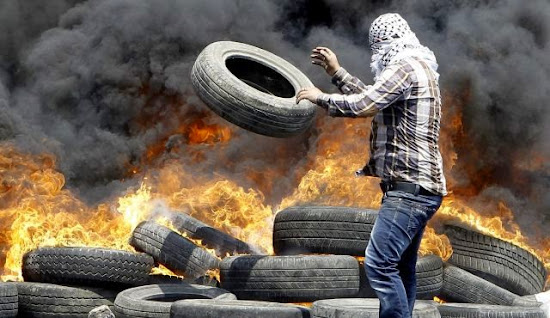
Arab rioters have taken to the streets of Israel, from Wadi Ara to the highways leading to wealthy suburbs in both north and south, hurling firebombs and stones, and lighting tires aflame. Israel's highways are beginning to look like the West Bank or East Jerusalem. The riots subsided briefly on Sunday morning and resumed at full force on Sunday evening, following news of the arrest. Police were forced to shut down major thoroughfares over the course of the demonstration, as the rioters targeted cars entering the Jewish neighborhoods. Nearly 200 demonstrators were arrested in a single day of clashes.
Jewish claims to moral superiority must not be taken at face value. Extremists are capable of and have carried out far more extensive massacres over the course of Israel's recent history. Baruch Goldstein's murder of 29 Palestinians in Hebron is the most well-known of these attacks, but many other examples exist: the Bat Ayin underground's plan to wipe out a Palestinian girls' school, deserted soldier Eden Natan-Zada's murder of four innocent Arab passengers on a bus in Shfaram, contractor Asher Weisgan's targeted shootout of four of his Palestinian workers, the arson of a home in Sinjil which trapped and killed an entire Palestinian family.
The Israeli Arab demonstrations and concurrent clashes with police have drawn the war between Jews and Arab across the Green Line, into the affluent suburbs of secular Israel. Their riots were preceded by a venomous popular campaign among right-wing Israelis – not even those considered extreme - calling for bloody revenge over the murder of the three Israeli teens. What will stop these Jewish revenge-seekers from countering their Arab counterparts in Israel in a bloody face-off?
Those who are capable of burning a teenager alive are capable of taking up arms against their enemy masses in the Israeli Arab sector. The Israeli government, however, is not capable of issuing a firm declaration without forgiving society for its Jewish morality in comparison with its neighbors and the "lone" extremists responsible for these attacks.
Unless Netanyahu acts on his pledge of cracking down on the right-wing violence, his claims of Jewish superiority will backfire and leave Israel not only in further isolation but in a bloody sectarian war.
A cloud of secrecy has hovered over the police investigation, but suspicions that Jewish rightists were behind the murder was clear from the start, in both the Israeli and Palestinian public. Prime Minister Benjamin Netanyahu himself condemned the murder immediately after on the basis of it having been the act of Jewish extremists, even as a strict gag order kept the details of the probe undercover.
Rumors began flying as the police kept mum that 16-year-old Mohammed Abu-Khdeir was killed by members of his own family over unsubstantiated claims that he was a homosexual, or by a rival clan for some yet-to-be-determined settling of debts. The teenager's family insisted that this was not an honor killing and that their son was a good student with no enemies. The false claims continued to circulate, with the Israeli right-wing eager to prove to themselves and to others that Jews could not be behind such a heinous crime.
There was little doubt that this was the work of Jewish terrorists. The abduction was carried out less than 12 hours after the three Israeli teenagers abducted and murdered three weeks before were laid to rest and amidst rampant demonstrations of Israeli Jews in Jerusalem calling for blood and death to the Arabs.
The gag order was sealed again Sunday just hours after the initial details of the investigation were revealed, at the behest of the Shin Bet, which is holding the Jewish suspects in custody. One small piece of information managed to filter through before the file was removed from public information, however: that the same six suspects were linked to the abduction attempt of a 9-year-old boy in the same East Jerusalem neighborhood of Shoafat just a day before Abu Kheidar's kidnap and grisly murder.
Netanyahu again condemned the murder, in his first press conference in more than two years. "Israel does not differentiate between terror," Netanyahu said, vowing to crack down on Jewish extremists with the same vigorousness Israel uses against Palestinians. "As I condemn the calls of death to Arabs, I condemn calls of death to Jews." In the same breath, he followed by declaring that what differentiates Israel from its neighbors is that the latter welcomes murderers and terrorists and names streets and squares after them.
Netanyahu's weakened condemnation, to play into the Israeli sentiment that Jews could not be responsible for such an act, were followed by a harsher and more surprising remark by his right-wing Economy Minister, Naftali Bennett, who proposed subjecting Jewish terrorists to the same legal retributions accorded to Palestinians convicted of security offenses.
The prime minister's quick clarification of Jews' moral superiority will do little to douse the flames engulfing Israel, nor will the gag order reinstated on the investigation, leaving open conspiracy theories and unsettled suspicions.

Arab rioters have taken to the streets of Israel, from Wadi Ara to the highways leading to wealthy suburbs in both north and south, hurling firebombs and stones, and lighting tires aflame. Israel's highways are beginning to look like the West Bank or East Jerusalem. The riots subsided briefly on Sunday morning and resumed at full force on Sunday evening, following news of the arrest. Police were forced to shut down major thoroughfares over the course of the demonstration, as the rioters targeted cars entering the Jewish neighborhoods. Nearly 200 demonstrators were arrested in a single day of clashes.
Jewish claims to moral superiority must not be taken at face value. Extremists are capable of and have carried out far more extensive massacres over the course of Israel's recent history. Baruch Goldstein's murder of 29 Palestinians in Hebron is the most well-known of these attacks, but many other examples exist: the Bat Ayin underground's plan to wipe out a Palestinian girls' school, deserted soldier Eden Natan-Zada's murder of four innocent Arab passengers on a bus in Shfaram, contractor Asher Weisgan's targeted shootout of four of his Palestinian workers, the arson of a home in Sinjil which trapped and killed an entire Palestinian family.
The Israeli Arab demonstrations and concurrent clashes with police have drawn the war between Jews and Arab across the Green Line, into the affluent suburbs of secular Israel. Their riots were preceded by a venomous popular campaign among right-wing Israelis – not even those considered extreme - calling for bloody revenge over the murder of the three Israeli teens. What will stop these Jewish revenge-seekers from countering their Arab counterparts in Israel in a bloody face-off?
Those who are capable of burning a teenager alive are capable of taking up arms against their enemy masses in the Israeli Arab sector. The Israeli government, however, is not capable of issuing a firm declaration without forgiving society for its Jewish morality in comparison with its neighbors and the "lone" extremists responsible for these attacks.
Unless Netanyahu acts on his pledge of cracking down on the right-wing violence, his claims of Jewish superiority will backfire and leave Israel not only in further isolation but in a bloody sectarian war.
Monday, June 30, 2014
With bodies of kidnapped teens found, Israel is now waging war against Hamas
It was clear to the Shin Bet from the very beginning of its search for the three abducted teenagers and their kidnappers in the West Bank that there was little chance of finding the boys alive.
The investigation began seven hours after the boys were kidnapped, due to the failure of the police to operate accordingly, to respond to one of the boys' desperate plea for help or to track the call in the hours that followed.
The Shin Bet relied on two means of intelligence and two spheres of search over the last 19 days: They employed human intelligence (Shin Bet case officers, sources in the field, using agents and collaborators, and forensic evidence) and signet (wiretapping and analysis of data). Based on the lack of forensics aside from the burnt car abandoned by the kidnappers, and to the fact that there were no claims of responsibility from any individual or organization, the Shin Bet did not have even the slightest evidence to assess that the three were still alive.
Based on that assessment, the Shin Bet opened two spheres of search: one to locate the kidnappers and the other to locate the teens – or their bodies.
Security forces raided Hebron, near the site of the kidnapping and the believed home base of the kidnappers. The Shin Bet had listed Marwan Kwasame and Amar Abu Aysha as prime suspects within three days of the kidnapping, after learning that the two Hamas militants had disappeared just hours before the incident. Both have a history of militancy in the Hebron area, and both have been arrested in Israel in the past.
The Israeli forces turned homes upside down by the dozen, arrested hundreds of Hamas operatives and suspects, and searched in the river valleys and farms surrounding the area for some evidence of eithers' whereabouts.
The Shin Bet managed to narrow down the huge swath of land near Hebron to the exact spot where they found the boys' bodies at about 6 P.M. on Monday evening, but they still have not managed to track down the kidnappers. The manhunt is still underway, and the Shin Bet is certain it will manage to locate them. It believes that the kidnappers have not managed to escape the West Bank or even find refuge in the northern part of the territory, and estimates that they are still hiding in the Hebron area.
Two main questions, aside from the kidnappers' location, remain. The first is whether the kidnappers intended all along to abduct and kill, or whether they panicked in their attempt to bargain their hostages for a prisoner release and shot their victims in the head after one of the boys made a desperate call to the police hotline and whispered, "They kidnapped me."
As neither Kwasame nor Abu Aysha hold particularly high ranks in the Hamas, the second question is whether they carried out the kidnapping on their own accord, believing it to be their obligations as members of the Islamist organization, or if they were ordered to do so from the higher ranks.
The riddle can only be solved once the kidnappers have been found and the other Hamas operatives detained in the last week and a half of raids have been interrogated. The search for the kidnappers will continue and so will the overnight raids in Hebron.

Infographic created by Haaretz
Meanwhile, a fierce second front has erupted on the Gaza border. Some 70 rockets have been fired at the Gaza border communities since Operation Brother's Keeper began, the most severe of which struck a factory in the southern city of Sderot and ignited a massive fire.
The rocket attacks have been carried out mostly by splinter militant groups like an offshoot of the Palestinian Resistance Committees, and not by Hamas, exploiting Israel's second volatile front as its security and intelligence forces are focused on the West Bank.
Regardless of who is launching the rockets, Israel holds Hamas responsible for every attack, whether launched by those loyal to the ruling movement or rebel factions who refuse its authority.
The Israel Defense Forces has responded with harsh strikes on the coastal territory, killing more than half a dozen militants on their way to carry out a rocket attack. As the situation around the Gaza Strip continues, the IDF is intensifying its operation, with a focus on targeted assassinations in addition to pinpointed hits on the lower-level militants firing the rockets.
Israel's security cabinet convened late Monday after the bodies were found to determine further course of action, a meeting that was followed immediately by a new round of air strikes on Gaza. Former deputy minister of strategic affairs, Tzachi Hanegbi, has said it is not clear how many of Hamas' leaders will remain alive following the IDF strikes.
The trained eyes of Israel's defense establishment are on alert to threats from both the West Bank and the Gaza Strip, and to the developments in its neighbors to the north, Iraq and Syria. After a near two-year period of calm, escalation has resumed. Israel has made it clear that it will not tolerate any attacks on its territory or its citizens, and will use its mighty hand to stop them.
Israel's political goal, from the beginning of the operation, was to convince Mahmoud Abbas to annul the Palestinian Authority's partnership with its former rival Hamas. With the recent barrage of rockets from Gaza, Israel is using the opportunity to take the matter into its own hand and strike Hamas in its heartland. The Palestinian factions acting on their own and firing rockets will only encourage a harsher Israeli response.
The investigation began seven hours after the boys were kidnapped, due to the failure of the police to operate accordingly, to respond to one of the boys' desperate plea for help or to track the call in the hours that followed.
The Shin Bet relied on two means of intelligence and two spheres of search over the last 19 days: They employed human intelligence (Shin Bet case officers, sources in the field, using agents and collaborators, and forensic evidence) and signet (wiretapping and analysis of data). Based on the lack of forensics aside from the burnt car abandoned by the kidnappers, and to the fact that there were no claims of responsibility from any individual or organization, the Shin Bet did not have even the slightest evidence to assess that the three were still alive.
Based on that assessment, the Shin Bet opened two spheres of search: one to locate the kidnappers and the other to locate the teens – or their bodies.
Security forces raided Hebron, near the site of the kidnapping and the believed home base of the kidnappers. The Shin Bet had listed Marwan Kwasame and Amar Abu Aysha as prime suspects within three days of the kidnapping, after learning that the two Hamas militants had disappeared just hours before the incident. Both have a history of militancy in the Hebron area, and both have been arrested in Israel in the past.
The Israeli forces turned homes upside down by the dozen, arrested hundreds of Hamas operatives and suspects, and searched in the river valleys and farms surrounding the area for some evidence of eithers' whereabouts.
The Shin Bet managed to narrow down the huge swath of land near Hebron to the exact spot where they found the boys' bodies at about 6 P.M. on Monday evening, but they still have not managed to track down the kidnappers. The manhunt is still underway, and the Shin Bet is certain it will manage to locate them. It believes that the kidnappers have not managed to escape the West Bank or even find refuge in the northern part of the territory, and estimates that they are still hiding in the Hebron area.
Two main questions, aside from the kidnappers' location, remain. The first is whether the kidnappers intended all along to abduct and kill, or whether they panicked in their attempt to bargain their hostages for a prisoner release and shot their victims in the head after one of the boys made a desperate call to the police hotline and whispered, "They kidnapped me."
As neither Kwasame nor Abu Aysha hold particularly high ranks in the Hamas, the second question is whether they carried out the kidnapping on their own accord, believing it to be their obligations as members of the Islamist organization, or if they were ordered to do so from the higher ranks.
The riddle can only be solved once the kidnappers have been found and the other Hamas operatives detained in the last week and a half of raids have been interrogated. The search for the kidnappers will continue and so will the overnight raids in Hebron.

Infographic created by Haaretz
Meanwhile, a fierce second front has erupted on the Gaza border. Some 70 rockets have been fired at the Gaza border communities since Operation Brother's Keeper began, the most severe of which struck a factory in the southern city of Sderot and ignited a massive fire.
The rocket attacks have been carried out mostly by splinter militant groups like an offshoot of the Palestinian Resistance Committees, and not by Hamas, exploiting Israel's second volatile front as its security and intelligence forces are focused on the West Bank.
Regardless of who is launching the rockets, Israel holds Hamas responsible for every attack, whether launched by those loyal to the ruling movement or rebel factions who refuse its authority.
The Israel Defense Forces has responded with harsh strikes on the coastal territory, killing more than half a dozen militants on their way to carry out a rocket attack. As the situation around the Gaza Strip continues, the IDF is intensifying its operation, with a focus on targeted assassinations in addition to pinpointed hits on the lower-level militants firing the rockets.
Israel's security cabinet convened late Monday after the bodies were found to determine further course of action, a meeting that was followed immediately by a new round of air strikes on Gaza. Former deputy minister of strategic affairs, Tzachi Hanegbi, has said it is not clear how many of Hamas' leaders will remain alive following the IDF strikes.
The trained eyes of Israel's defense establishment are on alert to threats from both the West Bank and the Gaza Strip, and to the developments in its neighbors to the north, Iraq and Syria. After a near two-year period of calm, escalation has resumed. Israel has made it clear that it will not tolerate any attacks on its territory or its citizens, and will use its mighty hand to stop them.
Israel's political goal, from the beginning of the operation, was to convince Mahmoud Abbas to annul the Palestinian Authority's partnership with its former rival Hamas. With the recent barrage of rockets from Gaza, Israel is using the opportunity to take the matter into its own hand and strike Hamas in its heartland. The Palestinian factions acting on their own and firing rockets will only encourage a harsher Israeli response.
Sunday, June 1, 2014
Hezbollah, Al-Qaida or lone wolf? Brussels shooting bears marks of Islamist world war's new face

When a professional gunman, wearing a baseball cap and carrying a simple sports bag, walked into the Brussels Jewish Museum last Saturday and opened fire on four innocent victims, killing three and leaving the fourth with critical brain injuries, the media in both Israel and Belgium were quick to posit that this was the work of a well-oiled Islamist machine targeting members of the Israeli intelligence community.
The fact that Emanuel and Mira Riva, who were killed in the shootout, were both employees of Israeli government factions under the auspices of the Prime Minister's Office, led to early and uncorroborated assumptions that the two – or at least the wife - were Mossad operatives and deliberate targets of the shooter, tied to either Hezbollah or Al-Qaida.
While the calculated manner of the shooting, as well as the choice of a Jewish institution, indeed point to the hand of a trained Islamist terrorist, it is highly doubtful that the Rivas were specifically targeted as representatives of the Israeli intelligence community.
It is true that Hezbollah has long targeted Israeli and Jewish targets the world over, a threat it intensified in the wake of its senior commander Imad Mughniyeh's assassination in 2009, with a particular focus on Israelis part and parcel to the office of those perpetuators – the Mossad, or better known in covert Israeli speak, the Prime Minister's Office.
But it is also true that neither of the Rivas was a Mossad operative: both were accountants, he a former employee of the Nativ immigration agency that aided Russian Jewish emigres, and she a clerk. Neither were prime targets for the organization, as an Israeli officer would have been.
While the possibility remains that the attack was orchestrated by affiliates of Hezbollah or Al-Qaida, there is little to indicate that it was ordered by the higher ranks of either.
The evidence collected so far, including the lack of organizational support at the scene of the crime and the failure to pinpoint a network of other suspects, indicate that the shooting was carried out by either a local cell of the Islamic Jihad or by a lone gunman.
The Brussels shooter was a professional; that is a fact that cannot be disputed. With little forensic evidence to narrow down the identity of the gunman, investigators are relying on security footage from the museum, which captured him walking calmly into the tourist attraction, pulling out an AK-47 Kalashnikov rifle, shooting at his targets, and in just as measured a walk with which he entered, leaving the premises after completing the deed. He even remembered to zip his bag. Despite earlier reports, the gunman was alone at the scene of the shooting, and no getaway car awaited him, nor is there evidence that he received on-spot logistical support.
A viable suspect has been arrested, a 29-year-old Frenchmen of Algerian descent, named Mehdi Nemmouche. He was caught by authorities at a bus station in Marseille, en route from Amsterdam with a stop in Brussels. In his bag, which French police say was searched as part of a routine drug inspection, was an AK-47 Kalshnikov rifle, a revolver and ammunition, a GoPro camera said to be worn by the Brussels shooter and the baseball cap and clothing seen in CCTV on the body of the gunman during the attack.
A French police source called Nemmouche, who is still in custody and maintained the right to silence in the first 24 hours of his arrest, "an expert gunman and a crap fugitive." Shortly after Nemmouche's arrest, authorities released a video in which a voice, apparently belonging to the Frenchman, describes the shooting as an "attack against the Jews."
Nemmouche was not stopped by chance. He was already circulating in the French database as a national who had traveled to Syria to train and fight with jihadis there. His inspiration for Islamist warfare was apparently gleaned during his near year-long stay in a French prison, where he was incarcerated for robbing a convenience store.
The Brussels shooting bears remarkable similarities to the attack in Toulouse in 2012, when gunman Mohamed Mera, affiliated with Jihad but acting alone, shot and killed four people outside a Jewish school.
Like Mera, the Brussels gunman wore a personal miniature camera on his chest. And like Mera, his was clearly the work of an Islamist targeting Jews, though not specifically Israelis, and not necessarily ordered by the higher ranks of a global Jihad movement.
Just hours after the attack in Brussels, two Jewish men were assaulted leaving a synagogue in Paris and left in serious condition, harping back to the grotesque murder of Ilan Halimi, a 23-year-old French Jew tortured, burned and dismembered by a "lone" group in 2007.
If the Brussels attack was indeed carried out without instruction by the greatest terrorist groups of our time, the act of a "lone" wolf must not be dismissed as less threatening than if it were. The other two anti-Jewish attacks this week - both at the Kansas Jewish center and in Paris – were also carried out by "lone wolves".
A world war is on the rise, by an army of rogue soldiers whose motives are the same but do not answer to a specific commander. Thousands of Westerners have joined this war, both within the ranks of the jihadi groups in the Middle East and on their own accord in Europe and the United States.
Nowhere is safe, not on the green lawns of Kansas, nor on the cobblestone streets of Brussels, and certainly not in the war-torn cities of Syria. These lone wolves are not alone.
Subscribe to:
Posts (Atom)