A triathlete friend once told me, confidentially, that he straps on his heart rate monitor while in bed with his partner, to measure his pulse during sex. He updated me this week that he's found a new use for the toy, now that his work-out routine has been disrupted: he still wears it to bed, but now monitors his heart rate running to take shelter when the rocket siren sounds in Tel Aviv. In his mid-40s, he's managed to get it up to an impressive 180, and can sprint to the stairwell in just 23 seconds (including transition time of putting on pants and glasses). It turns out nothing improves interval speed quite like dodging rockets.
On the surface, Tel Aviv seems normal. The cafes are packed with hipsters and their dogs, top Israeli musicians grace the stages of the city's concert halls, and pedestrians still mill the streets as usual, on their way to work or to shop or to get a coffee.
Like the tide on our Mediterranean shores, however, the calm can be deceiving. Traffic has been noticeably lighter these last few weeks, cyclists have chosen to cancel their weekend rides on the empty roads for lack of shelter if a rocket strikes, and the beach that usually hums and booms mid-July is practically empty. Neil Young canceled his much-accoladed show this week, not as a boycott, but rather at the request of producers and the Home Front Command, fearing that rockets might be fired during his open air venue endangering the 20,000 or spectators who planned to attend the event.
"How much money have you saved on concerts this month now that nobody will appear in Tel Aviv?" a friend recently asked me. The answer is, a lot. When war rages, mostly outside of our borders, normal life is disrupted.
It's not Neil Young that I seek, though the idea of seeing this musician who sound-tracked my life as a teenager excited me; it's the freedom to live as I usually do in between wars – light, easy, sun-kissed. War rages in Gaza, nearly 300 dead so far, and my personal experience in the bubble of Tel Aviv is not immediate death, but rather fear and trepidation of what may come, a rocket or two a day, none fatal. As another triathlete friend recently said: 'Worst case scenario, you'll be injured and unable to run'. Indeed, this is the worst case scenario in my Tel Aviv under fire. I stick to the other side of the beach road when I run, where the buildings double as shelter (and shade from the burning sun).
Many Tel Aviv residents will harrumph, and wave away concerns from their friends abroad, saying it's not going to hit here and there's nothing to worry about, but the fear and the trepidation has taken its toll on everyone.
The pressure is on, it can be felt everywhere, but most people prefer to ignore the emotions bubbling beneath their bravado. This generalization of course does not apply to everyone, not to the poor families of the city's south, which don't stand in line with the leftist majority of the city, or the migrants, that have boosted the number of residents of our neighborhoods, fleeing from one war zone to the next, but it is the overwhelming experience here of the majority - the young and the cosmopolitan, those whose roots and future are in this city.
The war is on everybody's minds. The rockets get all of our heart rates rising, no matter what the likelihood of them hitting us and no matter if we are measuring with a fancy watch. Everyone has a friend, if not 10, called up for reserves, either awaiting entry to Gaza or one of the tens of thousands already inside.
In this bubble of ours, where anti-war and anti-occupation protests are the most prominent political expressions of those who do choose to acknowledge that we are at war, Tel Aviv residents are coping with the most effective weapon we have: humor. Black humor, as war requires. This is a city of pundits and humorists: from the pot-smoking 21-year-old just back from India to the 61-year-old artist sitting at the legendary Café Tamar, everybody has something to say.
When Prime Minister Benjamin Netanyahu fired his extreme right-wing deputy defense minister, Danny Danon, for opposing a cease-fire and threatening to quit if it happened, the internet exploded with memes and jokes: 'Hamas' greatest victory', one internet analyst wrote, 'is getting rid of Danon'. 'I wonder if the army will bulldoze his home,' wrote another. When an unnamed Israeli official told the BBC on Thursday that a cease-fire had been consolidated and was imminent, the blogosphere was quick to chime in: 'That official is Danon. Don't believe everything you read on the Internet'.
Chaim Levinson, a colleague of mine at Haaretz and master of one-liners, has shot off some of the best zingers so far this war: From harping on the worried mother calling for animal-rights activists to intervene in the brutal death of a bird shot down amid an Iron Dome interception to comments on supermarket behavior – 'people are packing it in now, like there's a war, I keep trying to explain, it's just a clearance sale (Hebrew cognate for military operation)' - the expression of distance from the reality experienced by our southern neighbors is clear.
A ground operation is underway in Gaza, more than 160 sites have been hit with a target on the tunnels that run from north to south, hiding Hamas' infrastructure, its headquarters and its depots. More than a thousand rocket have been fired at Israel, raining on its south at more frequency than any winter storm. The death toll has reached nearly 300 in Gaza and two in Israel, a soldier and a civilian.
The bubble of Tel Aviv is aware of these developments, fears them, and is trying as hard as it can to remain detached. This war can last another two weeks, if not more; our friends are on the front, and our summer is lost. At least there is humor, to keep our heads above the frothy waters, as Gaza burns, our south fears for its life, and we run to shelter every day. Here in Tel Aviv, life is at best normal, just interrupted. Maybe we will even be able to swim beyond the local currents soon and return to life as we know it. Until then, we can only hope for cease-fire.
Friday, July 18, 2014

Tuesday, July 15, 2014
The real goal of Egypt's cease-fire proposal: Disarming Hamas and demilitarizing Gaza
Israel's acceptance of the Egyptian cease-fire proposal effective immediately and to be implemented within 12 hours is not just an agreement to halt this round of hostilities, but rather a calculated move by Prime Minister Benjamin Netanyahu's government to begin the process of disarming Gaza and castrate its Islamist rulers of its military capabilities once and for all, with the backing of the Arab world and the international community.
Hamas immediately rejected the offer, declaring it "meaningless," and continued its rocket barrages on Israel with rapid fire, launching short-range rockets over the course of the morning and long-range missiles at Haifa and the Tel Aviv area in the early afternoon. Netanyahu declared within hours of the cabinet decision that Israel would escalate its attacks against Hamas should the latter refuse to the proposal, and ordered the Israel Defense Forces to strike the Gaza Strip mid-afternoon in response to the ongoing rocket fire. Even if Hamas agrees to Egypt's offer, the crossfire should not be expected to cease until seconds before implementation.
The proposal - which calls for an end to Israel's aerial, naval and ground strikes against Gaza, and for Hamas to halt its rocket fire against civilians and border attacks - stipulates that the two sides will meet in Cairo under Egyptian mediation within 48 hours of the cease-fire implementation. Gaza crossings will be opened to allow the passage of people and goods only once the security situation has stabilized, according to the proposal.
The Cairo meeting is intended not only to monitor the two sides' adherence to the cease-fire and to discuss the security issues, but to enable Israel and the mediators to advance to the real mission on the agenda: the demilitarization of the Gaza Strip.
Israel has maintained over the course of its eight-day operation in Gaza that it will not agree to any temporary truce with Hamas that would put a "band-aid" on the situation and allow it to resume its rocket fire on the civilian population this week or anytime in the future. Its goal is to "dismantle the terror machine."
The sole outcome the Israeli government is willing to accept is a complete destruction of Hamas' arsenal and a total disarmament of the Gaza Strip under an international resolution that forces the political echelon of the Islamist organization to drop its military capabilities and agree to a demilitarized Palestinian government there.
Both Israel and Egypt, along with most of the Arab world, have a vested interest in disarming Hamas entirely. Hamas is weaker now than it has ever been and will likely be coerced into agreeing to the cease-fire. Despite its currently stated objections, it has no other avenue on which to proceed. The Islamist movement is isolated and it is cornered.
Nearly 50 percent of Hamas rocket launchers and 40 percent of its projectiles have been destroyed in the last eight days; it has launched nearly half of the long-range missiles in its arsenal prior to the outbreak of the war, and without the support of Syria to refresh the influx of weapons, it will not be able to continue its rapid bombardment of Israel for long, with or without a cease-fire. A cease-fire would enable it to regain a place in the Arab world, from which it is now completely isolated and denounced. The pro-Islamist government in Qatar has been enlisted by Egypt as a partner in the mediation process set to commence in two days, to help in the rebuilding and rehabilitation of Gaza once the operation has ended.
Israel made it clear over the 24 hours that preceded its acceptance of the Egyptian proposal that a cease-fire was not on the agenda. Troops and tanks were deployed en masse on the Gaza border, poised for a ground operation, but government officials declared cautious willingness to actually invade.
Israel's acceptance of the cease-fire, therefore, is not surrender in the face of mass rockets, but rather its next calculated military move in its operation against Hamas, an alternative to a ground invasion.
A ground invasion would have enabled Israeli troops to search door-to-door for Hamas' leaders and its arsenal, but at the price of human lives, both Israeli and Palestinians. Former Israeli diplomat and analyst Danny Ayalon told me yesterday that Israel was willing to continue its aerial strikes on Gaza and sustain rocket fire for another 7-10 days, until Hamas' arsenal was exhausted. Israel is prepared to keep fighting, but knows that playing this round to the end will not prevent a future resumption of hostilities.
Israel was no doubt privy to the drafting of the Egyptian proposal and its careful stipulation of the "security issues" to be discussed in Cairo following implementation of the deal. Hamas officials told Arab media this morning that their rejection of the proposal was in part because they had not been told of its clauses in advance.
Egypt's mediation is its way of stepping into the operation, allied with Israel, to put an end to the terror machine in the Gaza Strip. If Hamas refuses to accept the cease-fire, it will in effect mean surrender to Israel. With the rest of the Arab world and the international community ready to clean Gaza of its arsenal, Hamas has no choice but to comply - if not today then tomorrow or in the next few days. Otherwise, the Israeli strikes will only intensify as will the Islamist movement's humiliation and isolation.
Hamas immediately rejected the offer, declaring it "meaningless," and continued its rocket barrages on Israel with rapid fire, launching short-range rockets over the course of the morning and long-range missiles at Haifa and the Tel Aviv area in the early afternoon. Netanyahu declared within hours of the cabinet decision that Israel would escalate its attacks against Hamas should the latter refuse to the proposal, and ordered the Israel Defense Forces to strike the Gaza Strip mid-afternoon in response to the ongoing rocket fire. Even if Hamas agrees to Egypt's offer, the crossfire should not be expected to cease until seconds before implementation.
The proposal - which calls for an end to Israel's aerial, naval and ground strikes against Gaza, and for Hamas to halt its rocket fire against civilians and border attacks - stipulates that the two sides will meet in Cairo under Egyptian mediation within 48 hours of the cease-fire implementation. Gaza crossings will be opened to allow the passage of people and goods only once the security situation has stabilized, according to the proposal.
The Cairo meeting is intended not only to monitor the two sides' adherence to the cease-fire and to discuss the security issues, but to enable Israel and the mediators to advance to the real mission on the agenda: the demilitarization of the Gaza Strip.
Israel has maintained over the course of its eight-day operation in Gaza that it will not agree to any temporary truce with Hamas that would put a "band-aid" on the situation and allow it to resume its rocket fire on the civilian population this week or anytime in the future. Its goal is to "dismantle the terror machine."
The sole outcome the Israeli government is willing to accept is a complete destruction of Hamas' arsenal and a total disarmament of the Gaza Strip under an international resolution that forces the political echelon of the Islamist organization to drop its military capabilities and agree to a demilitarized Palestinian government there.
Both Israel and Egypt, along with most of the Arab world, have a vested interest in disarming Hamas entirely. Hamas is weaker now than it has ever been and will likely be coerced into agreeing to the cease-fire. Despite its currently stated objections, it has no other avenue on which to proceed. The Islamist movement is isolated and it is cornered.
Nearly 50 percent of Hamas rocket launchers and 40 percent of its projectiles have been destroyed in the last eight days; it has launched nearly half of the long-range missiles in its arsenal prior to the outbreak of the war, and without the support of Syria to refresh the influx of weapons, it will not be able to continue its rapid bombardment of Israel for long, with or without a cease-fire. A cease-fire would enable it to regain a place in the Arab world, from which it is now completely isolated and denounced. The pro-Islamist government in Qatar has been enlisted by Egypt as a partner in the mediation process set to commence in two days, to help in the rebuilding and rehabilitation of Gaza once the operation has ended.
Israel made it clear over the 24 hours that preceded its acceptance of the Egyptian proposal that a cease-fire was not on the agenda. Troops and tanks were deployed en masse on the Gaza border, poised for a ground operation, but government officials declared cautious willingness to actually invade.
Israel's acceptance of the cease-fire, therefore, is not surrender in the face of mass rockets, but rather its next calculated military move in its operation against Hamas, an alternative to a ground invasion.
A ground invasion would have enabled Israeli troops to search door-to-door for Hamas' leaders and its arsenal, but at the price of human lives, both Israeli and Palestinians. Former Israeli diplomat and analyst Danny Ayalon told me yesterday that Israel was willing to continue its aerial strikes on Gaza and sustain rocket fire for another 7-10 days, until Hamas' arsenal was exhausted. Israel is prepared to keep fighting, but knows that playing this round to the end will not prevent a future resumption of hostilities.
Israel was no doubt privy to the drafting of the Egyptian proposal and its careful stipulation of the "security issues" to be discussed in Cairo following implementation of the deal. Hamas officials told Arab media this morning that their rejection of the proposal was in part because they had not been told of its clauses in advance.
Egypt's mediation is its way of stepping into the operation, allied with Israel, to put an end to the terror machine in the Gaza Strip. If Hamas refuses to accept the cease-fire, it will in effect mean surrender to Israel. With the rest of the Arab world and the international community ready to clean Gaza of its arsenal, Hamas has no choice but to comply - if not today then tomorrow or in the next few days. Otherwise, the Israeli strikes will only intensify as will the Islamist movement's humiliation and isolation.
Saturday, July 12, 2014
Hamas is waging a war of attrition, pushing to maximize casualties on both sides
Hamas is waging a war of attrition on Israel. Isolated from its former allies and benefactors, its smuggling tunnels flooded, Hamas has little to lose and much to gain by dragging Israel into all-out war.
Gaza's rulers want Israel to embark on a ground incursion, a move Prime Minister Benjamin Netanyhau has been desperate to avoid. Hamas' goal is to besiege Israel with rapid rocket fire, target its infrastructure, frighten the Israeli public, and wear down the defense establishment until it has no other option but to invade.
While Hamas' shorter-range rockets, aimed at dense population centers along the Gaza border, are capable of causing civilian casualties and damage with fairly decent accuracy, its mid and long-range projectiles – which can reach up to 200 km – are less accurate.
Hamas' aim is to kill and injure civilians, but the chances of such occurring with the long-range rockets are low. It therefore targets its projectiles at both civilian populations and at significant Israeli installations, such as power plants, major army bases, and the airport, for the added bonus of damaging Israel's infrastructure.
At least 7-10 rockets were fired at Tel Aviv on Saturday night, preceded by a Hamas warning that a barrage would occur at 9 P.M. exactly to mimic the IDF's 'knock on roof' policy warning civilians to seek shelter. The rockets were fired seven minutes later, with no hits and no casualties, and the city resumed its schedule of weekend activities within minutes. Such a heavy barrage has not been recorded in Tel Aviv since the Iraqi scuds of 1991, over a 21 day period, and the Egyptian bombing of the Central Bus Station in 1948.
The likelihood of a single civilian who does not seek shelter being struck by an M-75 or the Syrian-made M-302 is one in several millions. The eight Iron Dome defense batteries deployed across Israel have had about an 80- 90 percent success rate in intercepting the rockets fired so far during this operation, but they cannot stop fragments, especially the rocket engine, from surging to the ground after mid-air explosions. The danger to human life from these projectiles, therefore, is more likely to be caused by fallen shrapnel from an intercepted rocket or from accidents while seeking shelter in a panic.
A ground incursion would enable Hamas' underground city, with its hidden headquarters, to secure fatal blows to a high number of Israeli soldiers. An invasion would mean further destruction of its rocket cache, but Hamas is more concerned with killing and maiming Israeli soldiers, its "victory photo" in this war. With a significantly higher supply of short-range rockets, it will still be able to aim at civilians close to its border, even as its longer and mid-range missiles are destroyed.
At the beginning of the war, there were approximately 10,000 rockets in the Gaza arsenal, about 1/3 controlled by Islamic Jihad and the rest by Hamas. Of these, only some 200 M-75 (range of 75 km) and fewer than 50 M-302s (range of up to 200km) remain – without Syria's support, the stock of these long-range missiles is preciously dwindling. Hamas fires these mid and long-range missiles strategically, at peak morning and evening hours to maximize its chances of inflicting casualties and frightening the general public, but it knows that the supply will soon be exhausted, with no benefactor to replenish it. The only way for Israel to wipe out the thousands of shorter-range rockets still in cache and aimed at its south, is to go in on the ground to locate and demolish them.
Hamas and the Islamic Jihad have fired nearly 700 rockets at Israel from south to north over the course of five days - at a rate of about one per 10 minutes, according to Israel Defense Forces' figures – seriously wounding two people. Israel has struck almost 1200 Gaza targets – a rate of one per 4.5 minutes – killing nearly 130 people and causing about 800 injuries, most of them women and children. During the eight-day Operation Pillar of Defense in 2012, Israel attacked 1,500 sites in Gaza and killed 167 – close to the same number in nearly double the time.
Hamas hides its weapons under civilian institutions, such as schools and orphanages, hospitals and mosques. It tells Gazans to ignore Israel's warnings to abandon buildings targeted for air strikes, and orders them to stand on the rooftops as human shields. Its goal is not to reduce the number of casualties among its own people, but to increase the number of fatalities on both the Israeli side and on its own, as a propaganda tool to draw sympathy for its losses.

Smoke rises in Gaza after an Israeli strike. Photo by AFP.
Israel has limited human and signet intelligence in the Gaza Strip, sufficient enough to pinpoint a good deal of targets to demolish, but not all. Israel underestimated, for instance, the number of long range M-302s which had made their way into the Gaza arsenal – had Israel known, these would have the first and primary targets in its opening strikes, as they were in Lebanon in 2006 and Gaza in 2012.
The Israeli defense establishment has been putting off invasion for five days, but has declared readiness to do so, saying that the operation would continue until Gaza's arsenal was destroyed and quiet restored to the citizens of Israel. A ground incursion would be aimed at searching from house to house to locate the rocket depots and the underground launchers, and would provide Israeli forces with updated information via interrogation of prisoners – but at the cost of human life.
Netanyahu has said that a cease-fire is not on the agenda, but there are some indications already that secret encounters with U.S., Egypt, Qatar and the UN to broker an end to hostilities are in place behind the scenes. The Palestinian Authority, meanwhile, has drafted a United Nations resolution calling for an immediate cease-fire, but as the wording mentions only Israeli hostilities, and not Hamas rocket-fire, there is little chance the U.S. will approve.
With no end to Hamas' barrage of rockets and Israel's aerial operation, a ground incursion seems inevitable. One can only hope that the Israeli government has learned its lessons from the failures in Lebanon and in the 2009 Gaza war, and acts swiftly in the next infantry campaign to minimize the loss of both Palestinian and Israeli lives.
Gaza's rulers want Israel to embark on a ground incursion, a move Prime Minister Benjamin Netanyhau has been desperate to avoid. Hamas' goal is to besiege Israel with rapid rocket fire, target its infrastructure, frighten the Israeli public, and wear down the defense establishment until it has no other option but to invade.
While Hamas' shorter-range rockets, aimed at dense population centers along the Gaza border, are capable of causing civilian casualties and damage with fairly decent accuracy, its mid and long-range projectiles – which can reach up to 200 km – are less accurate.
Hamas' aim is to kill and injure civilians, but the chances of such occurring with the long-range rockets are low. It therefore targets its projectiles at both civilian populations and at significant Israeli installations, such as power plants, major army bases, and the airport, for the added bonus of damaging Israel's infrastructure.
At least 7-10 rockets were fired at Tel Aviv on Saturday night, preceded by a Hamas warning that a barrage would occur at 9 P.M. exactly to mimic the IDF's 'knock on roof' policy warning civilians to seek shelter. The rockets were fired seven minutes later, with no hits and no casualties, and the city resumed its schedule of weekend activities within minutes. Such a heavy barrage has not been recorded in Tel Aviv since the Iraqi scuds of 1991, over a 21 day period, and the Egyptian bombing of the Central Bus Station in 1948.
The likelihood of a single civilian who does not seek shelter being struck by an M-75 or the Syrian-made M-302 is one in several millions. The eight Iron Dome defense batteries deployed across Israel have had about an 80- 90 percent success rate in intercepting the rockets fired so far during this operation, but they cannot stop fragments, especially the rocket engine, from surging to the ground after mid-air explosions. The danger to human life from these projectiles, therefore, is more likely to be caused by fallen shrapnel from an intercepted rocket or from accidents while seeking shelter in a panic.
A ground incursion would enable Hamas' underground city, with its hidden headquarters, to secure fatal blows to a high number of Israeli soldiers. An invasion would mean further destruction of its rocket cache, but Hamas is more concerned with killing and maiming Israeli soldiers, its "victory photo" in this war. With a significantly higher supply of short-range rockets, it will still be able to aim at civilians close to its border, even as its longer and mid-range missiles are destroyed.
At the beginning of the war, there were approximately 10,000 rockets in the Gaza arsenal, about 1/3 controlled by Islamic Jihad and the rest by Hamas. Of these, only some 200 M-75 (range of 75 km) and fewer than 50 M-302s (range of up to 200km) remain – without Syria's support, the stock of these long-range missiles is preciously dwindling. Hamas fires these mid and long-range missiles strategically, at peak morning and evening hours to maximize its chances of inflicting casualties and frightening the general public, but it knows that the supply will soon be exhausted, with no benefactor to replenish it. The only way for Israel to wipe out the thousands of shorter-range rockets still in cache and aimed at its south, is to go in on the ground to locate and demolish them.
Hamas and the Islamic Jihad have fired nearly 700 rockets at Israel from south to north over the course of five days - at a rate of about one per 10 minutes, according to Israel Defense Forces' figures – seriously wounding two people. Israel has struck almost 1200 Gaza targets – a rate of one per 4.5 minutes – killing nearly 130 people and causing about 800 injuries, most of them women and children. During the eight-day Operation Pillar of Defense in 2012, Israel attacked 1,500 sites in Gaza and killed 167 – close to the same number in nearly double the time.
Hamas hides its weapons under civilian institutions, such as schools and orphanages, hospitals and mosques. It tells Gazans to ignore Israel's warnings to abandon buildings targeted for air strikes, and orders them to stand on the rooftops as human shields. Its goal is not to reduce the number of casualties among its own people, but to increase the number of fatalities on both the Israeli side and on its own, as a propaganda tool to draw sympathy for its losses.

Smoke rises in Gaza after an Israeli strike. Photo by AFP.
Israel has limited human and signet intelligence in the Gaza Strip, sufficient enough to pinpoint a good deal of targets to demolish, but not all. Israel underestimated, for instance, the number of long range M-302s which had made their way into the Gaza arsenal – had Israel known, these would have the first and primary targets in its opening strikes, as they were in Lebanon in 2006 and Gaza in 2012.
The Israeli defense establishment has been putting off invasion for five days, but has declared readiness to do so, saying that the operation would continue until Gaza's arsenal was destroyed and quiet restored to the citizens of Israel. A ground incursion would be aimed at searching from house to house to locate the rocket depots and the underground launchers, and would provide Israeli forces with updated information via interrogation of prisoners – but at the cost of human life.
Netanyahu has said that a cease-fire is not on the agenda, but there are some indications already that secret encounters with U.S., Egypt, Qatar and the UN to broker an end to hostilities are in place behind the scenes. The Palestinian Authority, meanwhile, has drafted a United Nations resolution calling for an immediate cease-fire, but as the wording mentions only Israeli hostilities, and not Hamas rocket-fire, there is little chance the U.S. will approve.
With no end to Hamas' barrage of rockets and Israel's aerial operation, a ground incursion seems inevitable. One can only hope that the Israeli government has learned its lessons from the failures in Lebanon and in the 2009 Gaza war, and acts swiftly in the next infantry campaign to minimize the loss of both Palestinian and Israeli lives.
Thursday, July 10, 2014
Israelis and Palestinians have forgotten how this war began
The Israel Air Force has attacked more than 500 targets in the Gaza Strip in the last 48 hours, a trade of barbs with the near equal number of rockets fired at Israel, 30 of them long range to Tel Aviv northward, since the operation began.
As Palestinians and Israelis take cover on either side of the Gaza border, it seems both have forgotten why this war started in the first place.
Prime Minister Benjamin Netanyahu tiptoed into this operation last week carefully and hesitatingly, knowing neither side was interested in an escalation. Netanyahu knew that an all-out war would end not only in bloodshed, but in further international isolation for Israel.
When his foreign minister and faction partner Avigdor Lieberman publicly split with him over their policy in Gaza, Netanyahu was forced into action: a ruthless aerial campaign over the Strip to prove Israel's steadfastness in responding to rocket fire. This was a reality even right-wing Netanyahu wanted to avoid, but the barrage of rockets and the political pressure left him little choice.
As the operation enters its third day, Netanyahu is helpless to the fact that a ground incursion may be next on the agenda. This is certainly Hamas' aspiration, seen by its naval incursion Tuesday and subsequent failed attempt on Wednesday.
A ground incursion would mean fewer losses for Gaza, as the battles pinpoint on its own territory where it can fight with more control using weapons it has en masse that are easier to attain than the long-range missiles no longer readily available from its former benefactors in Iran. This would also give it a chance to wipe out Israeli forces in a way impossible under aerial strike – Hamas has already fired anti-aircraft missiles at Israeli jets, but its arsenal is limited and cannot be wasted for that effort.
Netanyahu said at the outset that neither Israel nor Hamas wanted escalation. The fragile Palestinian unity pact served for both as a deterrent. Hamas is weaker than ever, abandoned by Syria and Iran, and humiliated by Egypt, which has outlawed its allied Muslim Brotherhood and acted brutally to destroy the smuggling tunnels between Gaza and Sinai. Hamas' call to the Palestinian Authority was desperate, a last-ditch attempt to hover above water and maintain political and military legitimacy while hobbling on its last leg.
Israel recognized this weakness and sought to prevent reconciliation, in order to keep Mahmoud Abbas' Palestinian Authority clean and willing to concede to the conditions neither side managed to agree on in the exhausting nine months of failed peace negotiations.
Egypt's efforts to stymie Hamas' terrorist activities have been even significantly harsher than Israel's: it has repeatedly flooded its tunnels with sewage and destroyed hundreds of homes in the vicinity, damming not only Hamas' military capabilities but also its economic income, swallowing the profits that the Islamic organization has made over the years in illegal imports and taxation.
In the recent escalation, Hamas has suffered more losses in terms of strikes and casualties than Israel – hundreds of aerial attacks and more than two dozen killed – but has scored a victory with its surprise launching of at least three M-302 missiles, the longest-range projectiles in its cache, capable of reaching 200 km when lightly loaded and 150 km with a significant amount of warheads (145 kg). Its accuracy rate is within one kilometer, like its mid-range counterpart, the M-75 (similar to the Iranian Fajr). With just around 50 of these M-302s left in its arsenal, Hamas cannot afford to fire them at Israel with abandon.
These long-range missiles have already hit near Haifa's power station, and in Hadera – near the country's main power plant, and the only Israeli city to have absorbed missile attacks from both Gaza and from Lebanon in 2006. Hamas has also fired its mid-range missiles at Dimona, a mere few kilometers from Israel's nuclear reactor.
Its attacks are not indiscriminate: less targeted perhaps within Tel Aviv, to scare the public with albeit marginally inaccurate launches, but precise in attempt to demolish the infrastructure at energy and army bases. In addition to the few dozen M-302 remaining, there are a few hundred more M-75 mid-range projectiles in the Gaza cache, most in Hamas' cache and the rest overseen by the Islamic Jihad.
As the battle between Gaza and Israel escalates, the highways of Israel are now quiet, a far cry from the boiling Arab and Jewish riots over the kidnappings and deaths of the three Israeli and one Palestinian teens last week. Details of 16-year-old Mohammed Abu Khdeir's murder, apparently at the hands of Jewish extremists, are still under gag order, but the anger and calls for revenge have subsided into oblivion. If nothing, the Gaza front has calmed the embers in Jerusalem and the West Bank.
One should remember, however, that these were the embers that sparked the Gaza escalation. Without the rockets and the aerial strikes, media discourse and public outrage would still be focused on sectarian divides and a third intifada, and a demand to hunt the perpetrators of all four teenaged deaths, who have still not been verified or tried – and in the case of the West Bank kidnapping, have not even been found.
The cost of civilian life ranks high on Netanyahu's agenda, following the lessons of the previous Gaza wars in 2012 and 2009, and especially in Lebanon in 2006; less so in Gaza, where Hamas has stored caches of long-range missiles under civilian buildings, inviting Israeli strikes. Hamas has little to lose these days; its political, military and economic stability is at stake and it will not survive without the reinstated support of Iran or Syria, or alternately, a strong Palestinian Authority that recognizes it demands and bounds.
Fears of a Jewish-Arab backlash within the bounds of recognized Israel have been put on the back-burner for now, as have the prospects of renewed peace negotiations, while Israel and Gaza focus on the next mission at hand: destroying the other's resolve and securing international support.
As Palestinians and Israelis take cover on either side of the Gaza border, it seems both have forgotten why this war started in the first place.
Prime Minister Benjamin Netanyahu tiptoed into this operation last week carefully and hesitatingly, knowing neither side was interested in an escalation. Netanyahu knew that an all-out war would end not only in bloodshed, but in further international isolation for Israel.
When his foreign minister and faction partner Avigdor Lieberman publicly split with him over their policy in Gaza, Netanyahu was forced into action: a ruthless aerial campaign over the Strip to prove Israel's steadfastness in responding to rocket fire. This was a reality even right-wing Netanyahu wanted to avoid, but the barrage of rockets and the political pressure left him little choice.
As the operation enters its third day, Netanyahu is helpless to the fact that a ground incursion may be next on the agenda. This is certainly Hamas' aspiration, seen by its naval incursion Tuesday and subsequent failed attempt on Wednesday.
A ground incursion would mean fewer losses for Gaza, as the battles pinpoint on its own territory where it can fight with more control using weapons it has en masse that are easier to attain than the long-range missiles no longer readily available from its former benefactors in Iran. This would also give it a chance to wipe out Israeli forces in a way impossible under aerial strike – Hamas has already fired anti-aircraft missiles at Israeli jets, but its arsenal is limited and cannot be wasted for that effort.
Netanyahu said at the outset that neither Israel nor Hamas wanted escalation. The fragile Palestinian unity pact served for both as a deterrent. Hamas is weaker than ever, abandoned by Syria and Iran, and humiliated by Egypt, which has outlawed its allied Muslim Brotherhood and acted brutally to destroy the smuggling tunnels between Gaza and Sinai. Hamas' call to the Palestinian Authority was desperate, a last-ditch attempt to hover above water and maintain political and military legitimacy while hobbling on its last leg.
Israel recognized this weakness and sought to prevent reconciliation, in order to keep Mahmoud Abbas' Palestinian Authority clean and willing to concede to the conditions neither side managed to agree on in the exhausting nine months of failed peace negotiations.
Egypt's efforts to stymie Hamas' terrorist activities have been even significantly harsher than Israel's: it has repeatedly flooded its tunnels with sewage and destroyed hundreds of homes in the vicinity, damming not only Hamas' military capabilities but also its economic income, swallowing the profits that the Islamic organization has made over the years in illegal imports and taxation.
In the recent escalation, Hamas has suffered more losses in terms of strikes and casualties than Israel – hundreds of aerial attacks and more than two dozen killed – but has scored a victory with its surprise launching of at least three M-302 missiles, the longest-range projectiles in its cache, capable of reaching 200 km when lightly loaded and 150 km with a significant amount of warheads (145 kg). Its accuracy rate is within one kilometer, like its mid-range counterpart, the M-75 (similar to the Iranian Fajr). With just around 50 of these M-302s left in its arsenal, Hamas cannot afford to fire them at Israel with abandon.
These long-range missiles have already hit near Haifa's power station, and in Hadera – near the country's main power plant, and the only Israeli city to have absorbed missile attacks from both Gaza and from Lebanon in 2006. Hamas has also fired its mid-range missiles at Dimona, a mere few kilometers from Israel's nuclear reactor.
Its attacks are not indiscriminate: less targeted perhaps within Tel Aviv, to scare the public with albeit marginally inaccurate launches, but precise in attempt to demolish the infrastructure at energy and army bases. In addition to the few dozen M-302 remaining, there are a few hundred more M-75 mid-range projectiles in the Gaza cache, most in Hamas' cache and the rest overseen by the Islamic Jihad.
As the battle between Gaza and Israel escalates, the highways of Israel are now quiet, a far cry from the boiling Arab and Jewish riots over the kidnappings and deaths of the three Israeli and one Palestinian teens last week. Details of 16-year-old Mohammed Abu Khdeir's murder, apparently at the hands of Jewish extremists, are still under gag order, but the anger and calls for revenge have subsided into oblivion. If nothing, the Gaza front has calmed the embers in Jerusalem and the West Bank.
One should remember, however, that these were the embers that sparked the Gaza escalation. Without the rockets and the aerial strikes, media discourse and public outrage would still be focused on sectarian divides and a third intifada, and a demand to hunt the perpetrators of all four teenaged deaths, who have still not been verified or tried – and in the case of the West Bank kidnapping, have not even been found.
The cost of civilian life ranks high on Netanyahu's agenda, following the lessons of the previous Gaza wars in 2012 and 2009, and especially in Lebanon in 2006; less so in Gaza, where Hamas has stored caches of long-range missiles under civilian buildings, inviting Israeli strikes. Hamas has little to lose these days; its political, military and economic stability is at stake and it will not survive without the reinstated support of Iran or Syria, or alternately, a strong Palestinian Authority that recognizes it demands and bounds.
Fears of a Jewish-Arab backlash within the bounds of recognized Israel have been put on the back-burner for now, as have the prospects of renewed peace negotiations, while Israel and Gaza focus on the next mission at hand: destroying the other's resolve and securing international support.
Wednesday, July 9, 2014
Expected but not surprised: Hamas hits Tel Aviv
Israel's mostly complacent public in the center of the country is at war again, but is likely to forget this by the time the next cease-fire is declared within a few days or at worst, weeks. For most Israelis, the threat from the south –as the fronts on the east and the north - is a mere inconvenience, and proof that peace with the Palestinians is impossible.
Hamas to them is an illegitimate anti-Israeli entity whose revenge can be harsh, but only brief, while the recognized Palestinian Authority is the force that must be reckoned and reasoned with, though there too, most Israelis – despite the overwhelming number in favor of a two-state solution - see no partner, regardless of its overtures. This war is to the Israeli public another brief disturbance and another nail in the coffin of the peace process.
War in Israel since the second intifada, for most of the country's secular and moderately religious society, is a passing affair: while the south sustains massive hits on a daily and weekly basis, as East Jerusalem and the West Bank burn and Gaza is ruthlessly attacked, residents in the center of the country run fearfully with the spontaneous sirens and return to normalcy just as quickly. The same is true of the south, but the rate and frequency with which they are attacked has forced them into a more sober reality.
This month's conflict was spurred in the West Bank, with the kidnap and murder of three Israeli teens, and the subsequent revenge attack of a Palestinian of the same age. These events, which broiled the extreme right-wing in Jerusalem and the parts of West Bank, have taken a back burner now that Gaza has returned to the map.
As the rocket barrages burst into the center of Israel on Tuesday, an inconclusive five-star and star-studded affair with war on its agenda took place: Haaretz's acclaimed Israel's Conference on Peace. And there were even fireworks to punctuate the event.
Dozens of rockets were fired at Israel over the course of the evening – one over Tel Aviv in early evening and at least seven more in the center of the country after dark, including four identified in Jerusalem and a siren near the main power plant in Caesarea for the first time since the 2006 war in Lebanon - each met with slight alarm from residents and a quick return to business as usual. The southern city of Ashdod, once an anomaly and now a regular target, sustained multiple direct hits as well.
As Israel's leading politicians and security experts – Tzipi Livni, Yuval Diskin, Shimon Peres and more - rubbed elbows with its leftist elite and journalists at the conference in Tel Aviv, jihadists in the Gaza Strip took the opportunity to fire at the country's commercial and population center, intercepted just south of the city by the Iron Dome defense system. Participants of the peace conference learned of the sirens minutes later, and crowded the basement lobby to reassure friends and family that they were okay, and oh, how ironic.
As these center communities panicked, unused to rockets like their southern neighbors are,the Israel Air Force continued its attacks on militants in the Gaza Strip, killing at least nine throughout the day.
A short hour after the first Tel Aviv siren and before the nighttime barrage, Barack Obama's special assistant on the Middle East wrapped up Haaretz's peace conference calling on Israel to defend itself but to act responsibly, recalling Prime Minister Benjamin Netanyahu's own urging the evening before.
This call by Netanyahu was made Sunday night, just hours before Foreign Minister Avigdor Lieberman took his Yisrael Beiteinu faction out of its alliance with Likud - a clear prompt tothe prime minister to rethink his strategy and political support, and order the IDF to prepare for a ground incursion - a move he had adamantly tried to prevent, and which he agreed to in the wake of the political splint.
Hamas claimed responsibility for the four rockets fired at Jerusalem and the two at Tel Aviv on Tuesday night, declaring them M 75 missiles, the Islamist organization's greatest weapon so far. An M 75 missile is designed to reach that many kilometers when loaded with the strongest amount of explosives (40kg) it can handle, but can go as far as 90-100 km if packed lighter. A more powerful rocket was launched later that night against Hadera, less than two kilometers from Israel's main power plant. This is M-302, originally a Chinese artillery rocket modified and upgraded by Syria sold to Iran and smuggled to Gaza. It weighs 600kg with a war head of up to 175 though unguided and inaccurate it can reach up to 200km.
Israel estimates that around 400 of these missiles existed in the Gaza arsenal, split between Hamas and the Islamic Jihad before the night's barrage: a dozen were fired over the course of Tuesday evening and Wednesday morning, most of them either intercepted by the Iron Dome or left to hit open spaces. It is clear that without Iran's funding and supplies, the Islamist organization does not have a sufficient number in its cache to fire these treasures at an indiscriminate rate. With its limited supply, neither Hamas nor other militants will part quickly with these missiles. It is using these weapons as sparingly as possible.
The situation in Israel today - kidnappings, murders, and rockets rampant -is reminiscent of both October 2000, the critical moments before the second intifada, and November 2012, when Tel Aviv residents peeked out from their bubble for the first time since the intifada and realized that enemy missiles could reach their neighborhoods and force them to rethink just how relaxed to be in the midst of war on the southern front. For Tel Aviv and Haifa residents, scurrying from such far-range explosives-loaded missiles is a far-gone memory, last seen in 1991 during the Gulf War.
Hamas and its militant compatriots – jihadists which negate its rule - in the Gaza Strip know that 32 percent of the population in Jerusalem, mostly in its east and north, are Muslim. It has and will continue to aim its weapons away from this divisive community, focusing the large rockets on the Judean hills where the main Israel Defense Forces base in the region is located. Its attacks on Tel Aviv are far more indiscriminate: the residential center of this main city is as fair a target as a school in its north or a club in its south.
Israelis will continue to balk at the sound of the sirens and return to agenda immediately, as the south takes the real hits. Tel Aviv is not Sderot. Hamas and the Islamic Jihad have a limited arsenal they are unlikely to waste in a single night, and a truce between the sides is likely to be achieved before any real damage on the Israeli center can be achieved.
Israelis should be alert now, but not alarmed. They know now where to run in case of missiles – their municipalities have been told to prepare – and they know to heed the advice of local experts. They also know that just as Israel wants to avoid escalation, so does Hamas does not want an escalation – it has more to lose than Israel.
The recent days' attacks are a threat in response to threat, a mutual trade between Gaza and Israel. The Palestinian unity pact is on fragile hold and thus Hamas' security and support is waning. Both Netanyahu and Palestinian President Mahmoud Abbas recognize the hubris in this latest round of war games, and Hamas on its end is well aware too.
The Gaza front opened as Israel and the Palestinian Authority were engaged in solving the crisis of the four kidnapped teens'; From the start, Netanyahu's aim was to prove to Abbas that Hamas is indeed a terrorist group unworthy of a unity pact. In this sense, he has won – Abbas cannot sanctify his unity with Hamas as long as the rockets continue. And the Israeli public will continue to refuse its ever possibility – and thus a chance of an inclusive peace agreement with the two Palestinian territories - as long as the attacks continue on both fronts.
The cycle of violence and revenge continue.
Hamas to them is an illegitimate anti-Israeli entity whose revenge can be harsh, but only brief, while the recognized Palestinian Authority is the force that must be reckoned and reasoned with, though there too, most Israelis – despite the overwhelming number in favor of a two-state solution - see no partner, regardless of its overtures. This war is to the Israeli public another brief disturbance and another nail in the coffin of the peace process.
War in Israel since the second intifada, for most of the country's secular and moderately religious society, is a passing affair: while the south sustains massive hits on a daily and weekly basis, as East Jerusalem and the West Bank burn and Gaza is ruthlessly attacked, residents in the center of the country run fearfully with the spontaneous sirens and return to normalcy just as quickly. The same is true of the south, but the rate and frequency with which they are attacked has forced them into a more sober reality.
This month's conflict was spurred in the West Bank, with the kidnap and murder of three Israeli teens, and the subsequent revenge attack of a Palestinian of the same age. These events, which broiled the extreme right-wing in Jerusalem and the parts of West Bank, have taken a back burner now that Gaza has returned to the map.
As the rocket barrages burst into the center of Israel on Tuesday, an inconclusive five-star and star-studded affair with war on its agenda took place: Haaretz's acclaimed Israel's Conference on Peace. And there were even fireworks to punctuate the event.
Dozens of rockets were fired at Israel over the course of the evening – one over Tel Aviv in early evening and at least seven more in the center of the country after dark, including four identified in Jerusalem and a siren near the main power plant in Caesarea for the first time since the 2006 war in Lebanon - each met with slight alarm from residents and a quick return to business as usual. The southern city of Ashdod, once an anomaly and now a regular target, sustained multiple direct hits as well.
As Israel's leading politicians and security experts – Tzipi Livni, Yuval Diskin, Shimon Peres and more - rubbed elbows with its leftist elite and journalists at the conference in Tel Aviv, jihadists in the Gaza Strip took the opportunity to fire at the country's commercial and population center, intercepted just south of the city by the Iron Dome defense system. Participants of the peace conference learned of the sirens minutes later, and crowded the basement lobby to reassure friends and family that they were okay, and oh, how ironic.
As these center communities panicked, unused to rockets like their southern neighbors are,the Israel Air Force continued its attacks on militants in the Gaza Strip, killing at least nine throughout the day.
A short hour after the first Tel Aviv siren and before the nighttime barrage, Barack Obama's special assistant on the Middle East wrapped up Haaretz's peace conference calling on Israel to defend itself but to act responsibly, recalling Prime Minister Benjamin Netanyahu's own urging the evening before.
This call by Netanyahu was made Sunday night, just hours before Foreign Minister Avigdor Lieberman took his Yisrael Beiteinu faction out of its alliance with Likud - a clear prompt tothe prime minister to rethink his strategy and political support, and order the IDF to prepare for a ground incursion - a move he had adamantly tried to prevent, and which he agreed to in the wake of the political splint.
Hamas claimed responsibility for the four rockets fired at Jerusalem and the two at Tel Aviv on Tuesday night, declaring them M 75 missiles, the Islamist organization's greatest weapon so far. An M 75 missile is designed to reach that many kilometers when loaded with the strongest amount of explosives (40kg) it can handle, but can go as far as 90-100 km if packed lighter. A more powerful rocket was launched later that night against Hadera, less than two kilometers from Israel's main power plant. This is M-302, originally a Chinese artillery rocket modified and upgraded by Syria sold to Iran and smuggled to Gaza. It weighs 600kg with a war head of up to 175 though unguided and inaccurate it can reach up to 200km.
Israel estimates that around 400 of these missiles existed in the Gaza arsenal, split between Hamas and the Islamic Jihad before the night's barrage: a dozen were fired over the course of Tuesday evening and Wednesday morning, most of them either intercepted by the Iron Dome or left to hit open spaces. It is clear that without Iran's funding and supplies, the Islamist organization does not have a sufficient number in its cache to fire these treasures at an indiscriminate rate. With its limited supply, neither Hamas nor other militants will part quickly with these missiles. It is using these weapons as sparingly as possible.
The situation in Israel today - kidnappings, murders, and rockets rampant -is reminiscent of both October 2000, the critical moments before the second intifada, and November 2012, when Tel Aviv residents peeked out from their bubble for the first time since the intifada and realized that enemy missiles could reach their neighborhoods and force them to rethink just how relaxed to be in the midst of war on the southern front. For Tel Aviv and Haifa residents, scurrying from such far-range explosives-loaded missiles is a far-gone memory, last seen in 1991 during the Gulf War.
Hamas and its militant compatriots – jihadists which negate its rule - in the Gaza Strip know that 32 percent of the population in Jerusalem, mostly in its east and north, are Muslim. It has and will continue to aim its weapons away from this divisive community, focusing the large rockets on the Judean hills where the main Israel Defense Forces base in the region is located. Its attacks on Tel Aviv are far more indiscriminate: the residential center of this main city is as fair a target as a school in its north or a club in its south.
Israelis will continue to balk at the sound of the sirens and return to agenda immediately, as the south takes the real hits. Tel Aviv is not Sderot. Hamas and the Islamic Jihad have a limited arsenal they are unlikely to waste in a single night, and a truce between the sides is likely to be achieved before any real damage on the Israeli center can be achieved.
Israelis should be alert now, but not alarmed. They know now where to run in case of missiles – their municipalities have been told to prepare – and they know to heed the advice of local experts. They also know that just as Israel wants to avoid escalation, so does Hamas does not want an escalation – it has more to lose than Israel.
The recent days' attacks are a threat in response to threat, a mutual trade between Gaza and Israel. The Palestinian unity pact is on fragile hold and thus Hamas' security and support is waning. Both Netanyahu and Palestinian President Mahmoud Abbas recognize the hubris in this latest round of war games, and Hamas on its end is well aware too.
The Gaza front opened as Israel and the Palestinian Authority were engaged in solving the crisis of the four kidnapped teens'; From the start, Netanyahu's aim was to prove to Abbas that Hamas is indeed a terrorist group unworthy of a unity pact. In this sense, he has won – Abbas cannot sanctify his unity with Hamas as long as the rockets continue. And the Israeli public will continue to refuse its ever possibility – and thus a chance of an inclusive peace agreement with the two Palestinian territories - as long as the attacks continue on both fronts.
The cycle of violence and revenge continue.
Monday, July 7, 2014
Israel's fear of abandoning Jewish morality will backfire
Four days after a Palestinian teenager was kidnapped outside of an East Jerusalem mosque and burned alive in a forest nearby, the Shin Bet revealed partial details of its investigation: Six Israeli Jews believed to belong to an ad-hoc extremist group have been arrested.
A cloud of secrecy has hovered over the police investigation, but suspicions that Jewish rightists were behind the murder was clear from the start, in both the Israeli and Palestinian public. Prime Minister Benjamin Netanyahu himself condemned the murder immediately after on the basis of it having been the act of Jewish extremists, even as a strict gag order kept the details of the probe undercover.
Rumors began flying as the police kept mum that 16-year-old Mohammed Abu-Khdeir was killed by members of his own family over unsubstantiated claims that he was a homosexual, or by a rival clan for some yet-to-be-determined settling of debts. The teenager's family insisted that this was not an honor killing and that their son was a good student with no enemies. The false claims continued to circulate, with the Israeli right-wing eager to prove to themselves and to others that Jews could not be behind such a heinous crime.
There was little doubt that this was the work of Jewish terrorists. The abduction was carried out less than 12 hours after the three Israeli teenagers abducted and murdered three weeks before were laid to rest and amidst rampant demonstrations of Israeli Jews in Jerusalem calling for blood and death to the Arabs.
The gag order was sealed again Sunday just hours after the initial details of the investigation were revealed, at the behest of the Shin Bet, which is holding the Jewish suspects in custody. One small piece of information managed to filter through before the file was removed from public information, however: that the same six suspects were linked to the abduction attempt of a 9-year-old boy in the same East Jerusalem neighborhood of Shoafat just a day before Abu Kheidar's kidnap and grisly murder.
Netanyahu again condemned the murder, in his first press conference in more than two years. "Israel does not differentiate between terror," Netanyahu said, vowing to crack down on Jewish extremists with the same vigorousness Israel uses against Palestinians. "As I condemn the calls of death to Arabs, I condemn calls of death to Jews." In the same breath, he followed by declaring that what differentiates Israel from its neighbors is that the latter welcomes murderers and terrorists and names streets and squares after them.
Netanyahu's weakened condemnation, to play into the Israeli sentiment that Jews could not be responsible for such an act, were followed by a harsher and more surprising remark by his right-wing Economy Minister, Naftali Bennett, who proposed subjecting Jewish terrorists to the same legal retributions accorded to Palestinians convicted of security offenses.
The prime minister's quick clarification of Jews' moral superiority will do little to douse the flames engulfing Israel, nor will the gag order reinstated on the investigation, leaving open conspiracy theories and unsettled suspicions.
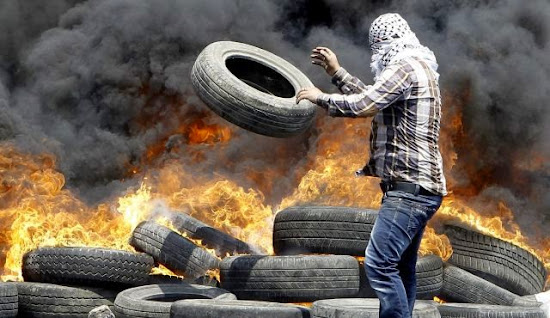
Arab rioters have taken to the streets of Israel, from Wadi Ara to the highways leading to wealthy suburbs in both north and south, hurling firebombs and stones, and lighting tires aflame. Israel's highways are beginning to look like the West Bank or East Jerusalem. The riots subsided briefly on Sunday morning and resumed at full force on Sunday evening, following news of the arrest. Police were forced to shut down major thoroughfares over the course of the demonstration, as the rioters targeted cars entering the Jewish neighborhoods. Nearly 200 demonstrators were arrested in a single day of clashes.
Jewish claims to moral superiority must not be taken at face value. Extremists are capable of and have carried out far more extensive massacres over the course of Israel's recent history. Baruch Goldstein's murder of 29 Palestinians in Hebron is the most well-known of these attacks, but many other examples exist: the Bat Ayin underground's plan to wipe out a Palestinian girls' school, deserted soldier Eden Natan-Zada's murder of four innocent Arab passengers on a bus in Shfaram, contractor Asher Weisgan's targeted shootout of four of his Palestinian workers, the arson of a home in Sinjil which trapped and killed an entire Palestinian family.
The Israeli Arab demonstrations and concurrent clashes with police have drawn the war between Jews and Arab across the Green Line, into the affluent suburbs of secular Israel. Their riots were preceded by a venomous popular campaign among right-wing Israelis – not even those considered extreme - calling for bloody revenge over the murder of the three Israeli teens. What will stop these Jewish revenge-seekers from countering their Arab counterparts in Israel in a bloody face-off?
Those who are capable of burning a teenager alive are capable of taking up arms against their enemy masses in the Israeli Arab sector. The Israeli government, however, is not capable of issuing a firm declaration without forgiving society for its Jewish morality in comparison with its neighbors and the "lone" extremists responsible for these attacks.
Unless Netanyahu acts on his pledge of cracking down on the right-wing violence, his claims of Jewish superiority will backfire and leave Israel not only in further isolation but in a bloody sectarian war.
A cloud of secrecy has hovered over the police investigation, but suspicions that Jewish rightists were behind the murder was clear from the start, in both the Israeli and Palestinian public. Prime Minister Benjamin Netanyahu himself condemned the murder immediately after on the basis of it having been the act of Jewish extremists, even as a strict gag order kept the details of the probe undercover.
Rumors began flying as the police kept mum that 16-year-old Mohammed Abu-Khdeir was killed by members of his own family over unsubstantiated claims that he was a homosexual, or by a rival clan for some yet-to-be-determined settling of debts. The teenager's family insisted that this was not an honor killing and that their son was a good student with no enemies. The false claims continued to circulate, with the Israeli right-wing eager to prove to themselves and to others that Jews could not be behind such a heinous crime.
There was little doubt that this was the work of Jewish terrorists. The abduction was carried out less than 12 hours after the three Israeli teenagers abducted and murdered three weeks before were laid to rest and amidst rampant demonstrations of Israeli Jews in Jerusalem calling for blood and death to the Arabs.
The gag order was sealed again Sunday just hours after the initial details of the investigation were revealed, at the behest of the Shin Bet, which is holding the Jewish suspects in custody. One small piece of information managed to filter through before the file was removed from public information, however: that the same six suspects were linked to the abduction attempt of a 9-year-old boy in the same East Jerusalem neighborhood of Shoafat just a day before Abu Kheidar's kidnap and grisly murder.
Netanyahu again condemned the murder, in his first press conference in more than two years. "Israel does not differentiate between terror," Netanyahu said, vowing to crack down on Jewish extremists with the same vigorousness Israel uses against Palestinians. "As I condemn the calls of death to Arabs, I condemn calls of death to Jews." In the same breath, he followed by declaring that what differentiates Israel from its neighbors is that the latter welcomes murderers and terrorists and names streets and squares after them.
Netanyahu's weakened condemnation, to play into the Israeli sentiment that Jews could not be responsible for such an act, were followed by a harsher and more surprising remark by his right-wing Economy Minister, Naftali Bennett, who proposed subjecting Jewish terrorists to the same legal retributions accorded to Palestinians convicted of security offenses.
The prime minister's quick clarification of Jews' moral superiority will do little to douse the flames engulfing Israel, nor will the gag order reinstated on the investigation, leaving open conspiracy theories and unsettled suspicions.

Arab rioters have taken to the streets of Israel, from Wadi Ara to the highways leading to wealthy suburbs in both north and south, hurling firebombs and stones, and lighting tires aflame. Israel's highways are beginning to look like the West Bank or East Jerusalem. The riots subsided briefly on Sunday morning and resumed at full force on Sunday evening, following news of the arrest. Police were forced to shut down major thoroughfares over the course of the demonstration, as the rioters targeted cars entering the Jewish neighborhoods. Nearly 200 demonstrators were arrested in a single day of clashes.
Jewish claims to moral superiority must not be taken at face value. Extremists are capable of and have carried out far more extensive massacres over the course of Israel's recent history. Baruch Goldstein's murder of 29 Palestinians in Hebron is the most well-known of these attacks, but many other examples exist: the Bat Ayin underground's plan to wipe out a Palestinian girls' school, deserted soldier Eden Natan-Zada's murder of four innocent Arab passengers on a bus in Shfaram, contractor Asher Weisgan's targeted shootout of four of his Palestinian workers, the arson of a home in Sinjil which trapped and killed an entire Palestinian family.
The Israeli Arab demonstrations and concurrent clashes with police have drawn the war between Jews and Arab across the Green Line, into the affluent suburbs of secular Israel. Their riots were preceded by a venomous popular campaign among right-wing Israelis – not even those considered extreme - calling for bloody revenge over the murder of the three Israeli teens. What will stop these Jewish revenge-seekers from countering their Arab counterparts in Israel in a bloody face-off?
Those who are capable of burning a teenager alive are capable of taking up arms against their enemy masses in the Israeli Arab sector. The Israeli government, however, is not capable of issuing a firm declaration without forgiving society for its Jewish morality in comparison with its neighbors and the "lone" extremists responsible for these attacks.
Unless Netanyahu acts on his pledge of cracking down on the right-wing violence, his claims of Jewish superiority will backfire and leave Israel not only in further isolation but in a bloody sectarian war.
Wednesday, July 2, 2014
Israel should take West Bank kidnapping as chance for peace, not war
 Police evacuating Arabs from riots in Jerusalem / Olivier Fittousi, Haaretz
Soon after the three kidnapped teens were laid to rest side-by-side in an emotional funeral attended by tens of thousands of mourners, Prime Minister Benjamin Netanyahu's security cabinet of senior ministers convened for the second time in 24 hours to determine its response to the attack and to the barrage of rockets that have been lobbied at southern Israel in the weeks that followed.
Just a few kilometers away, in the center of Jerusalem, dozens of right-wing Israelis gathered not for a vigil, but to cast their anger and frustration on any Palestinian they could find. They rampaged through the streets shouting racist slogans, hurling rocks and firing pepper spray, demanding "revenge" and death to the Arabs.
Five Palestinians were wounded and some 50 rioters were detained. The mob on Tuesday night carried the spirit of their comrades who chose a similar course of action the evening before, when it emerged that security forces has found the boys' bodies, 19 days after they were whisked away from a hitchhiking stand in the West Bank.
Before the meeting, Netanyahu and his defense minister, Moshe Ya'alon, lay out to the public the three tasks facing Israel's defense establishment: first, to find the abductors and all accomplices; second to destroy Hamas' infrastructure and membership in the West Bank; and third, "to expand the operation as far as required" to wipe out the military capabilities of the ruling Islamist organization in the Gaza Strip.
"We will not rest and we will not relax until we have reached every last one of them. It doesn't matter where they try to hide. We will reach them all," Netanyahu said.
Despite Netanyahu's harsh words, the cabinet is torn on how to respond, particularly on whether to turn its energies also on Gaza rather than just focusing its search on Hamas in the West Bank. The majority in cabinet fears that a violent circle will result in an all-out war, which both sides are eager to avoid.
Israel has struck Gaza targets by the dozens in the last few weeks, in response to the near hundred rockets fired at Israel, with the goal of reaching Hamas' operational ranks in the coastal territory.
Hamas is used to these reprisals, however, and most of its senior commanders have already taken refuge underground. The only exposed targets at this point are the low-level militants doing the footwork in Gaza and the weapons warehouses they man.
Ya'alon, for his part, while showing caution on the military front, is keeping up his image as a shoot-from-the-hip right-wing politician, proposing that a new settlement be created in response to the kidnapping in memory of the three teens. His suggestion is no less provocative than the activities of the vigilante rightists roaming the streets of Jerusalem seeking revenge with their eyes closed.
In the West Bank, the Palestinian Authority is considering its next move just as carefully. Palestinian President Mahmoud Abbas held out an olive branch in vulnerable hands three weeks ago when he told a forum of Arab foreign ministers, in their native language at a summit in Jeddah, that he condemned the kidnapping and resolved to find the perpetrators.
Abbas plans to approach the international community in a plea to halt Israeli military moves, fearing the domino effect it will create: a popular uprising, a third intifada, and a renewal of unrest in the West Bank that hasn't been felt in nearly a decade.
Hundreds of homes have been overturned and nearly 500 Palestinians have been arrested since Israel embarked on its operation to find the boys and their kidnappers. Palestinians will not tolerate the overnight raids and incursions much longer; the majority, unaffiliated with Hamas, wants to live in a state of stability, to escape the sense of occupation, without fear for family, property and peace of mind.
The defense establishment must focus on pinpointing the terrorists and their accomplices, but need not turn the West Bank upside down in its search – and most certainly should not open a wide-scale operation in the Gaza Strip. Such a move will only escalate enmity on both the Israeli and Palestinian sides.
More air strikes on Gaza will be met with multiple rocket barrages on the south; extensive raids in the West Bank will find its match with a populist response from angry young Palestinians; that uprising will spur further violence from the right-wing Israeli extremists. And so forth and so forth. There will be no end to the cycle.
The deadline for renewing peace talks expired in late April, but such dates are flexible; Israel and the Palestinians have been going at this process for 21 years. Israel should take the opportunity to see Abbas and his Palestinian Authority as a partner for peace, and together form a true partnership to wipe out the extremism within both Israel and the West Bank.
Israel is intent on destroying Abbas' unity agreement with Hamas. Attacking the West Bank and the Gaza Strip will only strengthen their fraternity. Israel now has the chance to fortify a bond with Abbas that will ensure security on both sides of the Jordan River, for the Israelis and the Palestinians on each side. Abbas has shown he is ready. Netanyahu must do the same.
Subscribe to:
Posts (Atom)